
Most audiophiles spend months researching amplifiers, DACs, and loudspeakers, then place their carefully chosen equipment on the first available flat surface. It's a common oversight, and one that quietly undermines everything else in the chain. The furniture supporting your audio system is not neutral. The material it's built from actively shapes how vibrational energy moves through your setup, how stable your components remain over years of use, and how the entire system performs at its best. Natural materials, particularly responsibly sourced hardwoods, bring properties to audio furniture that synthetic alternatives simply cannot replicate.
Table of Contents
- Understanding natural materials: Definition and core properties
- Natural vs. synthetic: Core differences and audio impact
- Nuances: Softwoods, tankwood hybrids, and moisture control
- Choosing natural materials for your audio furniture: Practical steps
- A deeper perspective: What most audiophiles miss about natural materials
- Optimize your setup with premium natural audio furniture
- Frequently asked questions
Key Takeaways
| Point | Details |
|---|---|
| What makes a material natural | Natural materials are minimally processed and offer unique benefits for audio furniture such as stability and damping. |
| Wood stability advantage | Dense hardwoods outperform synthetics for long-term load stability and prevention of sagging in audio setups. |
| Tankwood hybrid insights | Tankwood combines natural wood with minimal resin for enhanced density and damping, but is less 'pure' than traditional hardwoods. |
| Moisture control is crucial | Proper kiln drying to low moisture levels ensures that natural materials won't warp or crack over time. |
| Application matters most | Choosing and caring for premium natural materials is essential for maximizing performance and longevity in audiophile furniture. |
Understanding natural materials: Definition and core properties
With the misconception addressed, let's clarify what "natural material" really means for audiophile furniture. In the context of high-end audio, a natural material is one that is either unprocessed or only minimally processed, retaining its original molecular structure. That covers solid hardwoods like walnut, oak, cherry, and ash, as well as stone, bamboo, and certain metals at low processing levels.
What makes these materials relevant to audiophiles is a specific set of physical properties:
- Density: Higher density materials resist movement under load and reduce low-frequency resonance more effectively.
- Stiffness: A high stiffness-to-weight ratio ensures that shelves and uprights don't flex under the weight of heavy amplifiers or turntables.
- Internal damping: This is the material's ability to absorb and dissipate vibrational energy internally rather than transmitting it to your components.
- Moisture stability: Well-dried natural materials maintain dimensional accuracy over decades, unlike composites that absorb humidity and swell.
The distinction between natural and engineered materials shows up clearly at the molecular level. In solid hardwood, the cell structures, fibers, and grain patterns create irregular pathways that scatter and absorb vibrational energy before it can reach sensitive components. Engineered materials like MDF (medium-density fiberboard) are homogeneous by design, which actually makes them efficient at transmitting resonance rather than damping it. You can read more about how natural materials in HiFi furniture interact with acoustic performance in our detailed overview.
Innovations like tankwood, a process involving molecular fiber rearrangement for high density, homogeneity, and internal damping, show that even advanced acoustic materials trace their performance principles back to what natural wood already does. The goal is always to achieve greater density, more controlled fiber structure, and higher internal damping. Natural hardwoods deliver this without the manufacturing overhead.
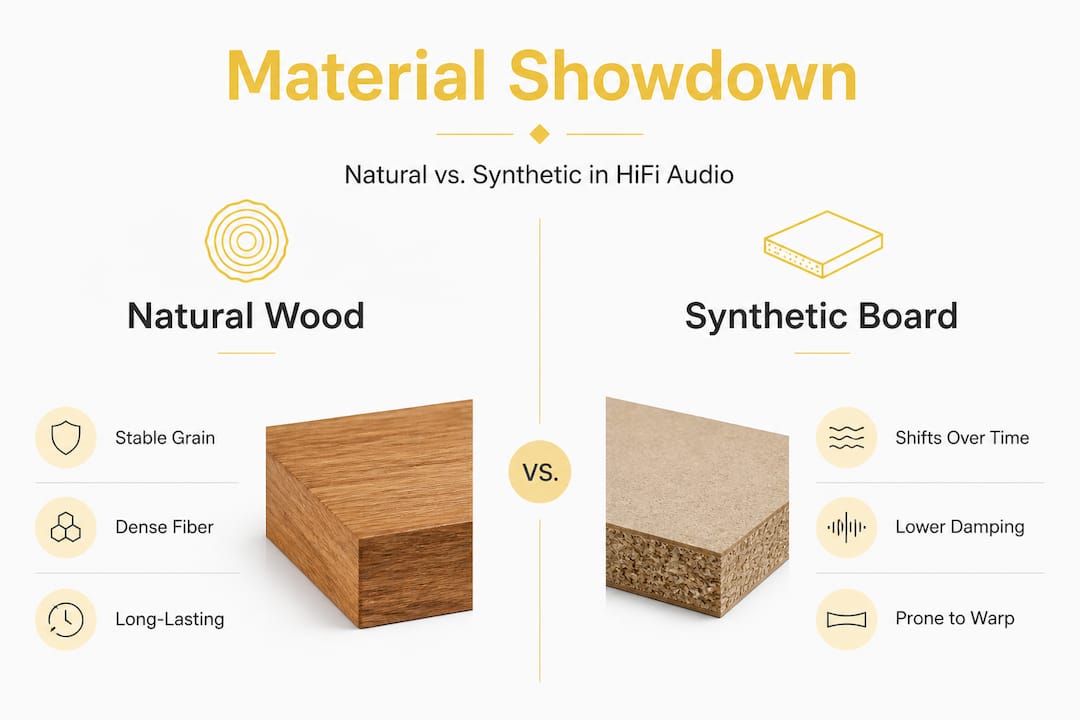
Pro Tip: When evaluating any wood for audio furniture, look for tight annual growth rings. Slow-growth timber develops a denser, more consistent grain structure, which translates directly to better resonance control and longer-term stability.
Natural vs. synthetic: Core differences and audio impact
After defining natural materials, it's time to see how they stack up against synthetics in real-world audio furniture. The comparison matters because MDF and composite materials dominate budget furniture, and understanding why they fall short helps you make a confident investment in something better.
The core issue with synthetic materials in load-bearing audio furniture is that their properties change over time. MDF swells with humidity and sags under sustained heavy load. A 30 kg amplifier sitting on an MDF shelf for five years will introduce measurable flex, which affects component leveling, platter alignment on turntables, and the contact geometry between equipment and shelf. Solid hardwood, properly dried and finished, maintains its geometry for decades under the same conditions.
| Property | Solid hardwood (oak, walnut) | MDF | Plastic composites |
|---|---|---|---|
| Internal damping | High (natural fiber structure) | Low to moderate | Low |
| Load stability | Excellent over decades | Degrades with humidity | Poor under sustained load |
| Moisture sensitivity | Low (kiln dried) | High (swells, sags) | Variable |
| Resonance behavior | Scatters and absorbs | Transmits efficiently | Transmits and amplifies |
| Longevity | 50+ years | 10-15 years typical | 5-10 years |
| Repairability | High (sanding, refinishing) | Limited | Very limited |
It's worth acknowledging that material science can be nuanced. Some research shows no perceptual difference between wood species in specific instrument applications like guitar soundboards, where the top is under string tension and vibrating actively. Audio furniture is a fundamentally different application. Here, the material is load-bearing and stationary, and the critical performance factor is how well it resists deformation and damps resonance passively, not how it vibrates actively.
"The furniture is not supposed to vibrate at all. The goal is to remove energy from the chain, not add it. That's where natural wood has a structural advantage over synthetic composites under load."
Understanding why wood is good for HiFi racks comes down to this basic principle: synthetic materials are engineered for consistency and cost efficiency in manufacturing, while natural hardwoods are optimized by millennia of growth for structural integrity and mechanical stability. Those priorities align directly with what audiophile furniture demands. For those looking to go deeper, our furniture-grade wood guide explains how grading standards apply specifically to audio applications.
Nuances: Softwoods, tankwood hybrids, and moisture control
Having explored the broad comparison, let's examine subtler material differences and technical specifics that separate a good rack from a great one.
Not all natural wood is equal. Softwoods like pine and spruce are technically natural materials, but their internal damping coefficients make them poor choices for load-bearing audio furniture. Softwoods like pine carry a damping coefficient in the range of 0.008 to 0.010, compared to 0.015 to 0.025 for dense hardwoods like oak or walnut. That may look like a small difference numerically, but in practice it means pine transmits significantly more vibrational energy to your components rather than absorbing it.
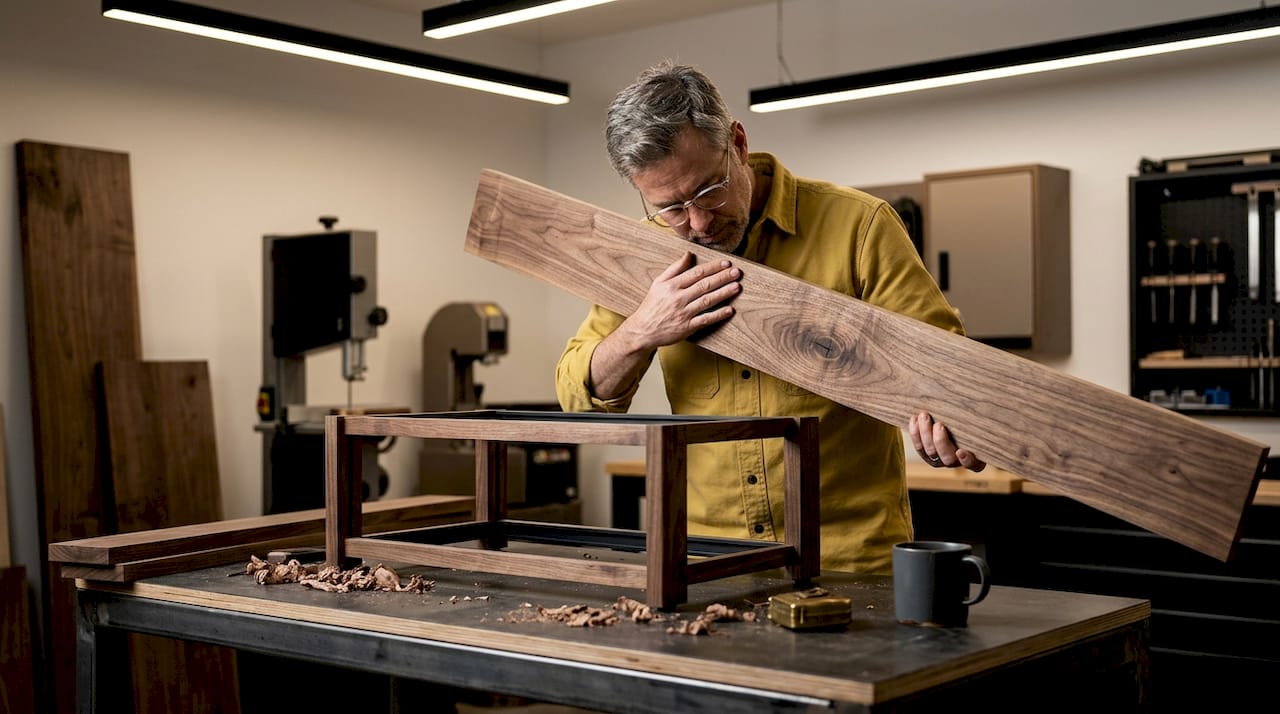
Here is a reference table for common materials and their relative acoustic properties:
| Material | Density (kg/m³) | Internal damping coefficient | Load suitability |
|---|---|---|---|
| Pine (softwood) | 480-560 | 0.008-0.010 | Poor |
| Ash (hardwood) | 650-740 | 0.012-0.018 | Good |
| Oak (hardwood) | 700-770 | 0.014-0.020 | Very good |
| Walnut (hardwood) | 630-700 | 0.015-0.022 | Very good |
| Tankwood hybrid | 900-1100 | 0.025-0.040 | Excellent |
| MDF | 700-800 | 0.008-0.012 | Moderate (degrades) |
Tankwood occupies a distinct category. It is produced by compressing natural wood under high pressure with minimal resin addition, causing molecular fiber rearrangement that increases both density and homogeneity. The result is a material with exceptionally high internal damping, making it well suited for applications where maximum resonance control is required. The trade-off is that it sits in a gray area between pure natural and hybrid, which matters to us and to many of our customers who prioritize material authenticity alongside performance.
Moisture control is the variable that separates professional-grade audio furniture from amateur builds, regardless of wood species. Here's the process we follow and recommend when evaluating any natural wood rack:
- Confirm kiln drying to 6-8% moisture content. Wood at this level is dimensionally stable across typical indoor humidity ranges of 40-60% relative humidity.
- Check for end-grain sealing. End grain absorbs moisture faster than face grain; proper sealing prevents differential expansion.
- Evaluate the finish. An appropriate oil, wax, or lacquer finish slows moisture exchange without fully sealing the wood, allowing it to breathe while minimizing movement.
- Consider your room environment. Rooms with wide seasonal humidity swings require more stable species or hybrid materials to prevent rack geometry from shifting over time.
You can explore how these principles apply to sourcing in our review of best sustainable audio materials, and see how they translate into finished pieces in our overview of handcrafted audio furniture.
Pro Tip: Ask your furniture maker for the moisture content certificate for the timber used in your rack. Reputable craftspeople will have this on file. If they don't, that tells you something important about their process.
Choosing natural materials for your audio furniture: Practical steps
With technical insight firmly in place, you can now apply this knowledge directly to your own setup. The process of selecting and caring for natural wood audio furniture follows a clear sequence that removes guesswork.
How to evaluate natural wood for racks and stands:
- Identify the species. Prioritize dense hardwoods. Oak, walnut, cherry, and ash are all excellent choices with well-documented acoustic and structural properties.
- Inspect the grain structure. Consistent, tight grain indicates slow growth and high density. Avoid pieces with wide, irregular grain or visible knots in structural sections.
- Ask about moisture content. As noted above, 6-8% is the target. Furniture built from wood at higher moisture content will shift and potentially crack as it dries in your home.
- Assess the joinery. Mortise and tenon, dovetail, and drawbored joints transfer load more effectively and last longer than pocket screws or dowels alone.
- Evaluate the surface treatment. The finish should protect without adding plastic-like hardness that changes the material's acoustic behavior.
The high density and internal damping properties that make tankwood and dense hardwoods suitable for load-bearing furniture are not abstract qualities. They are measurable, and any competent furniture maker should be able to speak to them. If the conversation stays purely aesthetic, push deeper.
Common mistakes to avoid:
- Choosing pine or other softwoods because they are cheaper or easier to find
- Ignoring moisture content and buying furniture made from green or insufficiently dried timber
- Prioritizing finish appearance over structural wood quality
- Assuming all "solid wood" products use furniture-grade timber throughout, including internal components
Long-term care for natural wood audio furniture:
- Maintain consistent room humidity between 45-55% relative humidity using a humidifier or dehumidifier as needed
- Apply a light coat of appropriate oil or wax annually to exterior surfaces
- Avoid placing furniture near heat sources, radiators, or air conditioning vents
- Inspect joinery annually and address any movement before it compounds
For a full approach to maintaining your investment, our guide on how to care and optimize audio furniture covers every stage of ownership in detail. You can also find relevant background on how natural materials and audio performance interact over the life of a piece.
A deeper perspective: What most audiophiles miss about natural materials
After providing actionable steps, let's reflect on what most audiophiles overlook when evaluating natural materials in their systems.
The conversation around materials in audio furniture often drifts toward theoretical sound improvement: will this specific wood make my system sound better? It's the wrong question, and chasing it leads people to undervalue what natural materials actually deliver consistently and measurably. Stability is the primary benefit. Not a subtle tonal shift, but the real, physical stability of a rack that holds its geometry for thirty years while keeping your components level, your tonearm geometry accurate, and your speaker stands firmly planted.
We've seen this pattern repeatedly: an audiophile invests in a world-class turntable, pairs it with a pine shelf, and then spends years blaming their cartridge for instability that originates in the furniture. The research acknowledges it too: studies show no perceptual difference in certain passive instrument applications, yet those same studies highlight how the mechanical context matters entirely. A vibrating guitar top and a load-bearing rack shelf are doing opposite jobs. Conflating the two leads to poor decisions.
There is also an authenticity dimension that we find consistently underestimated. Audiophiles invest in genuine, high-performance equipment because they care about what something actually is, not just how it appears to perform. Natural wood carries that same integrity. It has a history, a grain that no two pieces share, a warmth under your hands that no synthetic can fake. This isn't sentimentality. It's a recognition that the listening environment is part of the experience, and materials that are authentic contribute to that in ways that are hard to quantify but easy to feel.
The hard-won lesson from decades of building audio furniture is this: quality wood is not an expense. It's an investment that outlasts every component you'll ever place on it. Your amplifier will be replaced. Your turntable will be upgraded. The rack, built from properly dried walnut or oak with sound joinery, will still be holding your next system and the one after that. That longevity is where the real value lives. Explore how furniture choices transform your sound and style, and why the authenticity guide for audiophiles offers a framework for thinking about this more clearly.
Optimize your setup with premium natural audio furniture
If this guide has clarified why natural materials belong at the foundation of any serious audio setup, the next step is finding furniture that applies these principles without compromise.
At hifi-rack.com, we build our racks and speaker stands from responsibly sourced hardwoods, including walnut, cherry, ash, and oak, selected for density, grain consistency, and acoustic suitability. Every piece is kiln dried to the correct moisture content, finished with appropriate surface treatments, and assembled using traditional joinery that keeps your setup stable for decades. Whether you're looking to shop solid wood HiFi racks, explore our full range of Myro racks and stands, or simply browse our gallery of audio furniture for inspiration, you'll find pieces built on the same principles we've outlined throughout this guide. Craftsmanship and performance are not in tension here. They reinforce each other.
Frequently asked questions
What types of natural materials are best for HiFi racks?
Dense hardwoods like oak, walnut, and specialized hybrids such as tankwood offer the highest stability and internal damping for audio racks, with tankwood achieving high density and damping through molecular fiber rearrangement under compression.
Is there a difference in sound quality between natural and synthetic materials?
While some studies show no perceptual difference for certain instrument applications, natural materials provide measurably better stability and resonance control in load-bearing HiFi furniture, preventing the sagging and energy transmission that synthetic composites develop over time.
Why should moisture control matter when choosing natural materials?
Proper kiln drying to 6-8% moisture content is critical for long-term dimensional stability, preventing the warping, cracking, and joint failure that results when furniture-grade wood is not adequately dried before use.
Are hybrids like tankwood considered natural materials?
Tankwood uses compressed natural wood with minimal resin addition for enhanced density and damping, placing it mostly in the natural category with a modest synthetic component that improves performance while compromising some material purity.