
Two speakers built around identical electronics, same drivers, same crossover components, yet one sounds noticeably more alive, more grounded, more true. If you've heard this difference firsthand, you already sense that the explanation goes beyond circuit design. The enclosure material, the rack beneath the amplifier, the stand supporting the tweeter—these physical elements are active participants in the acoustic chain, not passive bystanders. This article works through what "natural material" actually means in audio engineering terms, how specific materials influence resonance, damping, and absorption, and what to look for when you're evaluating any piece of audio furniture for your system.
Table of Contents
- Defining natural materials in audio
- Acoustic properties: How natural materials affect sound
- Applications of natural materials in audio furniture
- How to choose: What matters most for audiophile systems
- Our take: Why natural materials are the audiophile's secret weapon
- Discover the difference with real natural material audio furniture
- Frequently asked questions
Key Takeaways
| Point | Details |
|---|---|
| Material choice matters | Natural materials like tankwood and birch have a direct impact on audio quality and resonance control. |
| Scientific evidence backs claims | Studies show that composites and real wood outperform synthetics in sound absorption and clarity. |
| Applications enhance listening | Natural materials are used in racks, stands, and panels for optimal audio performance. |
| Smart buying is essential | Look for true material specifications and construction quality when purchasing audio furniture. |
Defining natural materials in audio
With the context of sound quality introduced, let's clarify what actually counts as a "natural material" in the audio world. The term gets used loosely, which leads to real confusion when you're comparing products or reading manufacturer claims.
For audiophile purposes, natural materials are those derived directly from biological or geological sources with minimal synthetic processing. The most relevant categories include:
- Solid hardwoods: oak, walnut, cherry, ash, and birch are the most acoustically significant, each with distinct density and grain structures that affect how vibrational energy moves through them.
- Bamboo: a fast-growing grass technically, but with a fiber density comparable to many hardwoods, making it useful in lightweight structural applications.
- Cork: a cellular natural material with exceptional vibration isolation properties, commonly used in isolation feet and shelf liners.
- Natural fiber composites: materials derived from coconut husk, sugarcane fiber, kenaf, and similar plant sources, used in acoustic panels and enclosure filling.
- Stone and slate: dense, non-resonant materials used in plinths and isolation platforms.
What separates these from synthetic alternatives like MDF, particleboard, or engineered polymers is structural irregularity at the cellular level. Natural materials contain complex, non-uniform grain patterns and cell wall structures that create irregular pathways scattering and absorbing vibrational energy rather than reflecting it coherently. This is precisely why natural materials matter in high-end audio furniture design, where unwanted resonance is the enemy of accurate playback.
Scientific studies confirm that natural fiber composites including those derived from coconut fiber and kenaf significantly improve sound absorption, while birch enclosures demonstrate resonance behavior strongly influenced by shape geometry and internal filling materials.
Pro Tip: Before purchasing any audio rack or speaker stand, ask the manufacturer for the specific wood species and density rating. Vague terms like "solid wood construction" or "natural finish" tell you nothing about acoustic performance. You want species names, grain orientation, and construction method.
Acoustic properties: How natural materials affect sound
Now that we've identified key natural materials, let's dig into their scientific and practical impact on audio performance. The relationship between material structure and acoustic behavior is more direct than most audiophiles realize.
Tankwood is one of the most precisely engineered natural materials available for audio applications. It is compressed wood bonded with phenolic resin under high pressure, producing a material that maintains the structural character of wood while dramatically increasing density and homogeneity. Tankwood's internal damping properties deliver resonance-free sound reproduction, natural tonal balance, and tight, controlled bass response—characteristics that are difficult to replicate in standard MDF or polymer-based enclosures. The phenolic resin fills the microscopic voids between wood fibers, eliminating the air gaps that would otherwise create low-level coloration during playback.
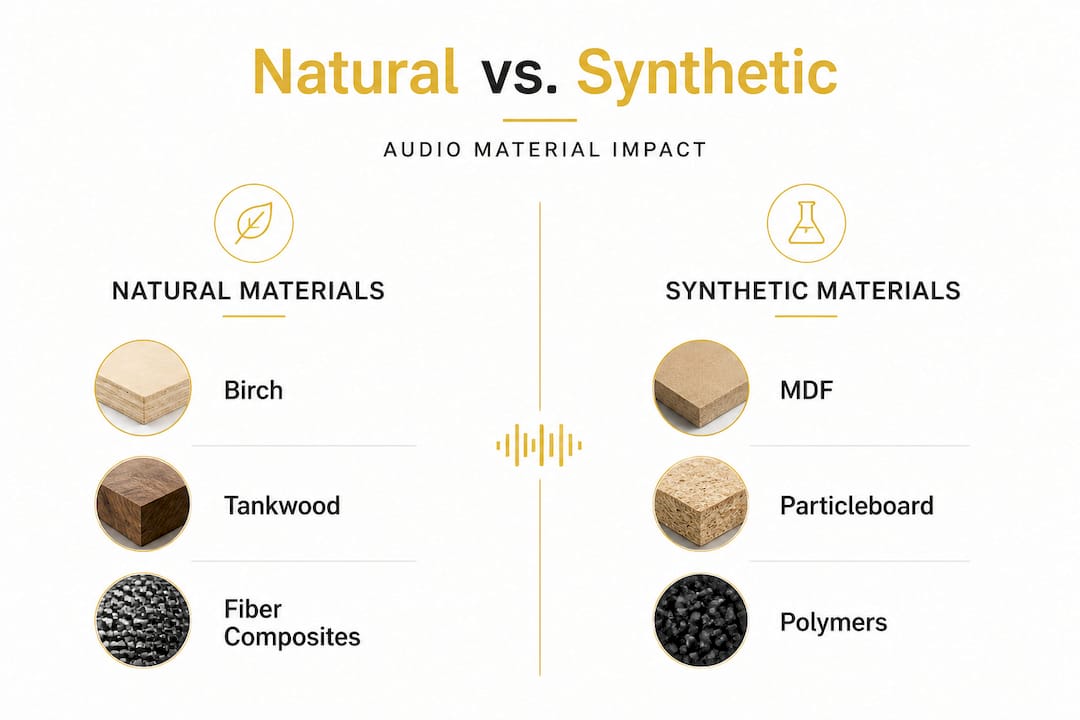
Birch behaves differently. Its relatively uniform grain and moderate density make it a classic choice for speaker enclosures precisely because its resonant character is predictable and tuneable. Enclosure designers have spent decades learning to shape birch cavities and select internal damping materials to shift its resonance peaks away from musically critical frequencies. Natural fiber composites used as internal fill materials inside birch enclosures absorb mid to upper-frequency energy that would otherwise excite cabinet walls and color the sound.
Here's a direct comparison of natural versus synthetic enclosure and furniture materials:
| Material | Density (kg/m³) | Resonance character | Damping behavior | Primary application |
|---|---|---|---|---|
| Tankwood | 1,100–1,300 | Very low, controlled | Excellent internal damping | Speaker enclosures, plinths |
| Solid birch | 600–700 | Moderate, tuneable | Good with fill materials | Enclosures, speaker stands |
| Solid walnut | 590–650 | Rich, warm coloration | Moderate natural damping | Audio racks, furniture |
| MDF | 700–800 | Broad, diffuse resonance | Poor without treatment | Budget enclosures |
| Particleboard | 600–700 | Loose, poorly controlled | Very poor | Low-cost furniture |
| ABS polymer | 1,000–1,100 | Sharp, brittle resonance | Requires added treatment | Budget enclosures |
"The acoustic difference between a well-chosen natural hardwood and a synthetic substitute isn't subtle on high-resolution systems. Solid materials transmit, scatter, and absorb vibrational energy according to their cellular architecture, and that architecture is something no manufacturing process has yet fully replicated."
The practical implications flow directly from this data. If your amplifier sits on a shelf made from particleboard or thin-gauge steel, micro-vibrations generated by transformer hum and airborne sound pressure are coupling into the chassis and affecting component performance. Understanding premium material advantages in this context is not abstract—it's the difference between components operating in a stable mechanical environment and those that are constantly being excited by low-level vibrational contamination.
Here are the key acoustic mechanisms, in order of relevance for audio furniture:
- Internal damping: The material's ability to convert mechanical vibration into heat through internal friction within its cellular structure.
- Stiffness-to-mass ratio: Stiffer, denser materials push resonance frequencies higher or lower; controlling this determines whether a rack or stand resonates within audible musical frequencies.
- Grain-based scattering: Irregular grain patterns in natural wood break up coherent vibrational wave fronts, preventing standing waves from establishing inside structural components.
- Decoupling geometry: How material thickness, joinery, and shelf geometry interact to prevent vibration pathways from forming between equipment and floor.
Consulting a guide to acoustic isolation will give you a deeper framework for evaluating these mechanisms in the context of rack design specifically.
Applications of natural materials in audio furniture
Understanding the science is just half the story; let's see how these materials show up in audio setups you might use. The applications span several categories of audio furniture, each with specific material requirements.
Audio racks are the most structurally demanding application. A quality rack must isolate multiple heavy components simultaneously while remaining mechanically stable under the combined weight of transformers, turntables, and amplifiers. Solid hardwoods such as walnut, cherry, and ash offer the density and grain complexity needed to interrupt vibration pathways between shelves. The guide to solid wood HiFi racks details exactly how construction method and wood choice interact to determine the acoustic performance of a rack in real listening rooms.

Speaker stands require a different balance of stiffness and mass. The goal is to mechanically ground the speaker to the floor while providing as little sympathetic resonance as possible. Dense materials like oak or tankwood are favored for their low resonance signature and high internal damping. Spike systems typically used on quality stands couple the stand's mass to the floor, and the stand material itself must not become a resonator between the speaker and the floor surface.
Speaker enclosures and cabinets are where natural fiber composites shine as internal damping materials. Natural fiber composites derived from kenaf and coconut fiber demonstrate measurably superior mid-frequency absorption compared to polyester fill, which is still widely used in budget speaker designs. The organic structure of plant fibers creates irregular surfaces at the microscopic level, reducing reflections inside the cabinet before they can excite the cone from behind.
Acoustic panels and room treatment represent a growing application for cork, bamboo, and compressed natural fiber boards. These materials offer useful absorption in the 500 Hz to 4 kHz range without introducing the sterility that some synthetic foam panels can add to a room's character.
Here's how common materials compare in practical listening room contexts:
| Material | Frequency range affected | Practical benefit | Typical application |
|---|---|---|---|
| Cork | 200–2,000 Hz | Vibration isolation, diffusion | Isolation platforms, feet |
| Kenaf fiber composite | 500–8,000 Hz | Mid/high absorption | Acoustic panels, cabinet fill |
| Solid walnut | Broadband structural | Resonance control | Racks, stands |
| Bamboo panel | 1,000–5,000 Hz | Diffusion and light absorption | Room panels |
| Coconut fiber | 500–4,000 Hz | Broadband mid absorption | Enclosure fill |
Key applications at a glance:
- HiFi racks: dense hardwood construction to interrupt vibration pathways between shelves and equipment
- Speaker stands: high-mass natural materials for mechanical grounding without sympathetic resonance
- Cabinet enclosures: birch or tankwood shells combined with natural fiber internal damping
- Isolation platforms: cork or slate under turntables and DACs for low-frequency isolation
- Room panels: bamboo and compressed fiber boards for diffusion and controlled absorption
Pro Tip: When selecting wood species for a rack in a room that already sounds warm or full in the lower midrange, favor tighter-grained species like cherry or ash over walnut. Walnut's characteristic warmth is a real acoustic quality, not just a visual one, and in certain rooms it can reinforce frequencies that are already slightly elevated.
How to choose: What matters most for audiophile systems
Armed with knowledge of materials and applications, here's how to confidently find the best fit for your own setup. Material claims in audio are sometimes vague or overstated, so a systematic evaluation approach protects your investment.
Follow these steps when assessing any natural material audio product:
- Verify species and density: Request the specific wood species and, ideally, a density figure. Tankwood's high density and stiffness are quantifiable and should be documented by serious manufacturers.
- Examine construction joinery: Dovetail, mortise-and-tenon, and similar traditional joints create structural rigidity that glued butt joints cannot match. Poor joinery introduces movement and resonance under load.
- Check finish type: Thick lacquer and polyurethane coatings can damp natural wood resonance in ways that alter acoustic character. Oil and wax finishes preserve the material's natural behavior more faithfully.
- Assess shelf thickness and geometry: Thicker shelves shift resonance frequencies lower and generally out of the musically critical range above 80 Hz. Ask about shelf dimensions, not just material.
- Evaluate spike or footer design: The quality and material of isolation footers determines how effectively vibrational energy is controlled at the contact points between rack, floor, and equipment.
- Request measurements where available: Some manufacturers publish impedance or resonance frequency data for their products. When available, this is far more informative than subjective adjectives.
- Consider your room's acoustic context: A rack that performs superbly in a lively, reflective room may behave differently in a heavily treated space. Knowing your room's character helps you make a material choice that complements rather than fights your existing acoustic environment.
Common pitfalls to avoid: ignoring the impact of veneer versus solid construction (veneer over MDF does not behave acoustically like solid wood), accepting "natural wood look" finishes as equivalent to genuine wood species, and overlooking the acoustic significance of what makes a good HiFi rack beyond its visual appearance.
Pro Tip: If you can measure your room's frequency response at the listening position before and after introducing new audio furniture, even basic measurements using a calibrated microphone and free software will often show quantifiable changes. This transforms a subjective impression into verifiable data and helps you understand exactly what the material change is doing in your specific room.
Our take: Why natural materials are the audiophile's secret weapon
Here is the pattern we see consistently: audiophiles spend months agonizing over cable upgrades and DAC choices, yet place their entire system on a particleboard rack without a second thought. The irony is that the rack is touching every piece of equipment simultaneously. No cable in the chain has that kind of total-system contact.
Natural materials represent what we think of as an "invisible upgrade." When they're working correctly, you don't notice them as a separate element—you simply hear your system performing at a higher level. There's no character being added by a well-designed solid walnut or oak rack. There's simply less mechanical noise, less vibrational contamination, and more of what your electronics and transducers are actually trying to tell you.
We also observe that the "exotic technology" narrative in audio marketing often distracts from material fundamentals. A compressed polymer chassis loaded with marketing-friendly branding will not outperform a genuinely dense, well-constructed hardwood structure for vibration control. Physics does not accommodate branding preferences.
The other dimension that specs don't capture is integration with creating premium audio spaces. A system in a room that feels cohesive and natural to be in tends to be listened to more often and for longer sessions. That subjective comfort feeds directly into how you perceive the music. A rack built from real walnut or cherry doesn't just perform better; it makes the listening environment feel like it was designed with intention, which it was.
Our position is straightforward: choose real materials, understand their acoustic properties, and treat the mechanical environment of your system with the same rigor you apply to component selection. The results, in our experience, are consistently worth it.
Discover the difference with real natural material audio furniture
If you're ready to experience these benefits firsthand, here's where craftsmanship and acoustic science meet for your system.
We build every product with responsibly sourced hardwoods, traditional joinery, and a four-generation understanding of how wood behaves over time and under load. Our approach is grounded in exactly the acoustic science covered in this article.
Explore our Myro Racks & Stands collection for handcrafted designs engineered around vibration control and natural material performance. If you're browsing our broader range, the full selection of solid wood Hi-Fi racks covers a variety of wood species, shelf configurations, and spike systems to match your specific setup. We're also committed to sustainable sourcing, and you can read more about our nature-friendly audio solutions and the standards we hold ourselves to on every piece we build.
Frequently asked questions
Are natural materials better than synthetic ones for audio furniture?
Natural materials like tankwood and birch provide resonance control and damping that synthetic alternatives like MDF or ABS struggle to match, particularly in high-resolution audio contexts where micro-level coloration becomes audible.
Does the type of wood or fiber really matter for sound?
Yes. Scientific studies show that birch, tankwood, and natural fiber composites each interact with acoustic energy in distinctly different ways, affecting resonance frequencies, absorption bandwidth, and overall tonal balance in measurable terms.
How can I tell if my audio rack uses real natural materials?
Check manufacturer specifications for the specific wood species, density rating, and construction method, and treat vague terms like "wood look," "wood finish," or "natural aesthetic" as red flags that suggest veneer over engineered board rather than genuine solid wood.
Do natural materials in audio furniture help room acoustics?
When properly implemented, natural materials in furniture reduce undesirable structural resonance and, in the case of exposed wood surfaces and natural fiber panels, contribute measurable diffusion and absorption that improves overall clarity and warmth in the listening environment.