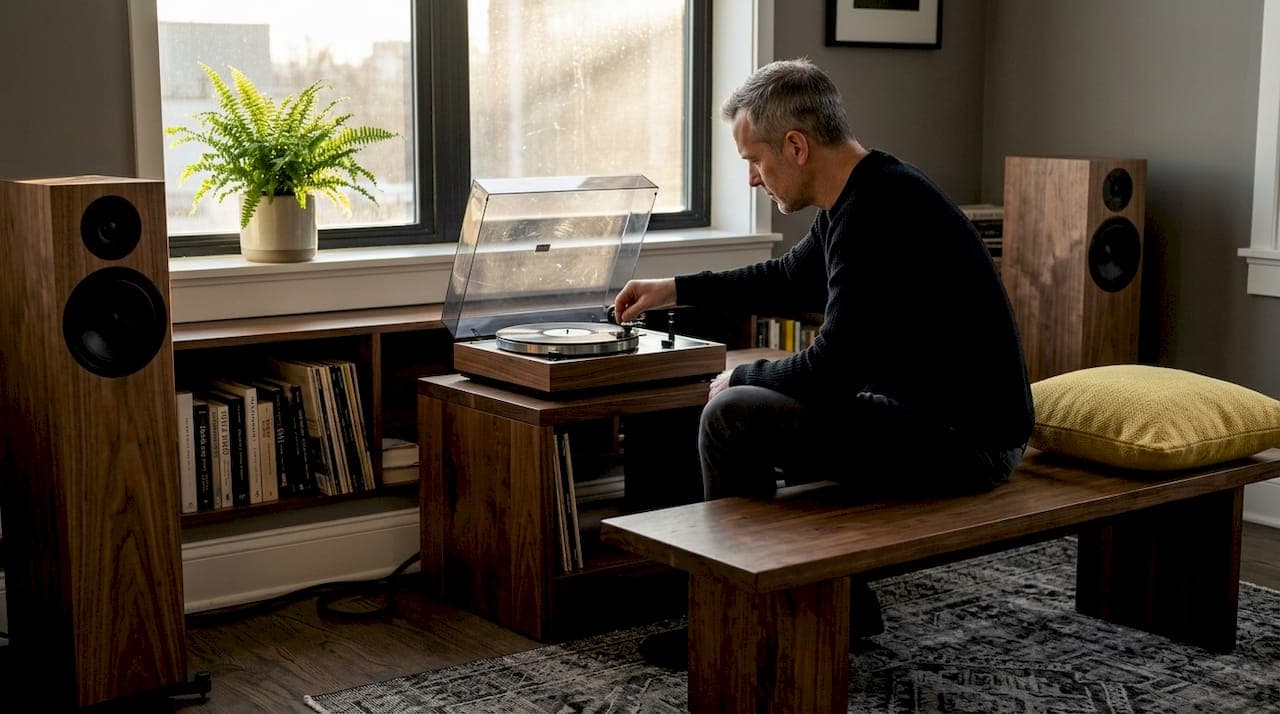
When audiophiles invest seriously in their listening rooms, they quickly discover that furniture does far more than fill space or signal taste. Authenticity in furniture is about genuineness and originality — whether a piece truly is what it claims in terms of maker, materials, and origin — and that distinction carries real weight in a high-fidelity audio context. A rack that looks the part but misrepresents its construction can color the sonic character of your system in ways you never intended. Understanding what authentic furniture actually means, and why it matters acoustically, is the foundation of a truly resolved listening setup.
Table of Contents
- What does authenticity mean in furniture?
- How authenticity influences home audio furniture
- Authenticity claims: Period originals vs. modern imitations
- Selecting authentic, acoustically effective furniture: Practical tips
- Why authenticity is not just about appearance: An audiophile's perspective
- Shop authentic Hi-Fi furniture and racks
- Frequently asked questions
Key Takeaways
| Point | Details |
|---|---|
| Authenticity is provenance | True furniture authenticity comes from verified maker, materials, and history—not surface style. |
| Acoustic authenticity matters | Furniture structure and damping can alter home audio performance, but the impact varies by context. |
| Modern replicas aren’t originals | Authentic-looking furniture is often visually similar but lacks genuine attribution or effects. |
| Practical selection is key | Careful evaluation of materials, construction, and documentation improves both fidelity and aesthetics. |
| Evidence beats assumptions | Empirical measurements help audiophiles prioritize real acoustic benefits over visual cues. |
What does authenticity mean in furniture?
The word "authentic" gets used loosely in furniture marketing, often reduced to a visual impression of quality or age. But in the world of antiques and collectibles, authenticity is defined as the accurate identification of true maker, age, origin, and materials — a piece is authentic when it has not been altered or misrepresented in a misleading way. That is a far more demanding standard than simply looking old or handmade.
For audiophiles, this definition matters on two levels. First, there is the collector's concern: you want to know that the furniture you are placing your equipment on is precisely what the maker or seller claims it to be. Second, and more critically for audio performance, there is the question of material authenticity. A rack described as solid walnut that is actually a walnut veneer over particleboard behaves very differently from a structural standpoint. The internal mass, grain structure, and resonant characteristics of those two constructions are not comparable.
What does authentic furniture actually look like in practice? There are several factors to examine:
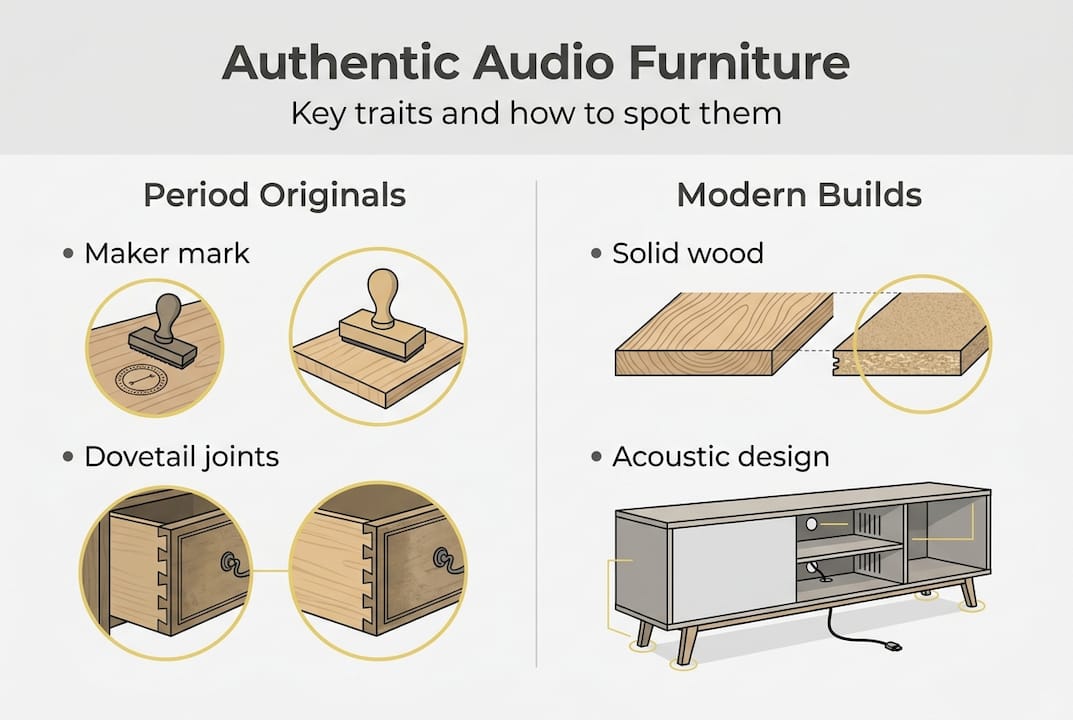
- Maker attribution: Is there documentation, a maker's mark, or provenance that confirms who built the piece and when?
- Material honesty: Are the structural members what they are claimed to be — solid hardwood, steel, or a specific species — rather than engineered substitutes with a convincing surface finish?
- Construction integrity: Does the joinery, hardware, and finish method match the claimed period, workshop, or production philosophy?
- Alteration history: Has the piece been modified, refinished, or repaired in ways that change its character or misrepresent its original state?
"An item is authentic when it has not been altered or misrepresented in a misleading way." This principle applies as strongly to a contemporary handcrafted audio rack as it does to a 200-year-old cabinet.
For audiophiles who are building a system over years, this matters because furniture decisions made on false premises are hard to reverse. You may spend time and money treating a resonance problem that originates from a rack built with inferior materials rather than the ones advertised.
How authenticity influences home audio furniture
Once you understand what authenticity means structurally, the connection to acoustic performance becomes clearer. Furniture interacts with your audio system through three primary mechanisms: structural damping, mass loading, and resonance coupling. Each of these is directly tied to the actual physical composition of the furniture — not its surface appearance.
Furniture affects acoustic outcomes through structural damping, mass, and resonance control, though the direction of audible impact depends on exactly what is being modified. A rack that is genuinely built from dense, slow-grown hardwood like walnut or ash will behave quite differently from one that mimics the visual grain of those species while relying on a filler core. The actual fiber density, cell structure, and moisture content of the wood determine how vibrational energy moves through the material and where it dissipates.
Here is a practical breakdown of how each mechanism operates in a real listening setup:
- Structural damping: The ability of a material to absorb and convert vibrational energy into heat rather than re-radiating it as sound. Denser hardwoods, particularly those with irregular grain patterns, naturally create more irregular pathways for vibrational energy to travel through, increasing dissipation.
- Mass loading: Heavier furniture structures with genuine material density resist movement when excited by speaker vibration. A rack with a solid hardwood shelf of 40mm or more behaves very differently from a veneered panel of the same thickness.
- Resonance coupling: Every piece of furniture has resonant frequencies at which it vibrates most readily. Authentic, well-constructed furniture with proper mass and joinery pushes those resonant peaks to frequencies that are less likely to interfere with the critical midrange and upper bass where most music lives.
Pro Tip: If you can, knock gently on a shelf with your knuckle before purchasing. A solid hardwood shelf produces a short, dense thud. A veneered engineered panel rings longer and sounds hollow at the edges. This is not a definitive test, but it is a quick first filter.
It is important to be precise here: damping changes may or may not be perceptually relevant depending on the overall system and room context. Not every material substitution will produce an audible difference in every setup. Empirical measurement and controlled listening comparisons are far more reliable than assumptions based on marketing language or visual impressions alone. This is precisely why we advocate measurement-informed decisions rather than simply trusting a label.
Authenticity claims: Period originals vs. modern imitations
A useful and often overlooked distinction exists between two very different categories of furniture that both carry the word "authentic" in their descriptions. Understanding this difference protects you from paying a premium for something that does not deliver what you expect.
| Category | Period originals | Modern authentic builds |
|---|---|---|
| Age | Pre-twentieth century or clearly dated period | Contemporary manufacture |
| Materials | Species and finishes of the era | Specified, genuine materials used as claimed |
| Provenance | Historical documentation or attribution | Maker documentation, material sourcing records |
| Acoustic relevance | Variable: aged wood behaves differently | High: controlled construction for specific performance goals |
| Verification method | Expert appraisal, documentation review | Material testing, maker transparency, site visits |
Period originals carry historical attribution and represent furniture that has survived decades or centuries. They can be extraordinary objects, but their acoustic behavior is not necessarily superior to a thoughtfully engineered modern rack. Aged wood can develop micro-cracks that alter its damping characteristics unpredictably. Joints may have been repaired with materials that introduce resonances the original builder never intended.

Modern pieces that intentionally imitate earlier wear and visual cues — distressed finishes, artificially aged hardware, faux patina — occupy a very different category from both period originals and genuinely authentic contemporary builds. They are essentially decorative props that borrow the aesthetic language of historical furniture without the material substance or the engineered intent of either. This is the pitfall most audiophiles encounter when shopping at mainstream furniture retailers with "vintage-inspired" audio furniture lines.
What to look for when evaluating authenticity claims:
- Species-specific documentation: A maker who genuinely uses American black walnut sourced from responsibly managed forests will be able to tell you where the wood came from, not just what it looks like.
- Construction method transparency: Traditional mortise-and-tenon joinery or solid board shelving is not an accident of design — it is a deliberate structural decision that a genuine maker will explain and stand behind.
- Finish honesty: An oil or wax finish on genuine hardwood behaves acoustically in ways that a polyurethane coating on engineered wood does not. The finish matters because it affects surface hardness and, to a small degree, surface reflection of airborne sound.
- Weight as a proxy: Genuine solid hardwood furniture is noticeably heavier than veneered alternatives of the same dimensions. This is not foolproof, but it is an immediate physical signal worth trusting.
Selecting authentic, acoustically effective furniture: Practical tips
With a clear understanding of what authenticity means and how it connects to acoustic outcomes, you can build a selection process that protects your investment and serves your listening system. Here is how we recommend approaching it.
Step-by-step selection framework:
- Define your performance priorities first. Are you primarily managing turntable microphonics? Controlling bass resonance between a subwoofer and a floor? Stabilizing a DAC that sits near a large speaker? Each goal points toward different structural priorities in the furniture you choose.
- Ask for material verification before purchasing. A reputable maker will provide species identification, sourcing documentation, and construction details without hesitation. Vagueness at this stage is a meaningful red flag.
- Evaluate mass and rigidity in person when possible. Place your hand on a shelf and push gently. A properly constructed solid wood shelf with genuine thickness should feel immovable. If it flexes at the corners, the material composition is almost certainly not what it claims to be.
- Research the maker's heritage and philosophy. Authentic furniture comes from builders with a consistent, documented history of working with specific materials and methods. A four-generation woodworking heritage, for example, is not a marketing story — it is a verifiable lineage that you can research and confirm.
- Request measurements or acoustic test data where available. This is an emerging standard in high-end audio furniture, and makers who invest in it demonstrate a genuine commitment to performance over aesthetics alone.
| Selection criterion | What to check | Red flag |
|---|---|---|
| Wood species | Species name, origin, sourcing documentation | Generic "hardwood" with no further detail |
| Shelf thickness | Measured thickness, not nominal | Thin panels with heavy edge banding |
| Joinery type | Mortise-and-tenon, dowel, or metal fastener detail | Stapled or glued-only construction |
| Finish type | Oil, wax, or specified coating | No finish information provided |
| Maker transparency | Direct contact, site visits, documentation | Anonymous supply chain |
For acoustic performance goals, the underlying mechanics — rigidity, damping, and coupling between the furniture and your components or room floor — matter considerably more than superficial "aged" appearance or decorative distressing. A rack that looks beautiful but flexes under load is not serving your system; it is complicating it.
Pro Tip: Before committing to any audio furniture purchase, place a spirit level on your current rack while music plays at moderate volume. Even subtle flex or vibration will be visible. Then try the same test on a sample of the furniture you are considering, if the maker allows. The difference between a rigid, authentic hardwood structure and a veneered alternative is often immediately visible at this basic level.
Why authenticity is not just about appearance: An audiophile's perspective
Here is something we see consistently among audiophiles who are just beginning to take furniture seriously: they spend months researching amplifiers and source components down to the last measured parameter, then select a rack based entirely on how it looks in a photograph. The irony is that the rack supports every component in the chain and influences the mechanical environment of each one.
The conventional wisdom in audio communities tends to treat furniture as a secondary concern, something to sort out after the "real" components are chosen. We think that framing gets it backwards. The mechanical foundation of your system shapes everything that sits on it. A rack that resonates sympathetically with bass frequencies is not a neutral element — it is an active participant in your system's behavior, whether you recognize it or not.
The deeper lesson from years of working with audiophiles and musicians is that empirical measurement matters far more than visual impressions or brand reputation alone. We have seen expensive furniture perform poorly and modestly priced authentic hardwood racks perform exceptionally well, because the latter was built with genuine material integrity and structural intent. The acoustic authenticity of a piece — meaning whether its physical properties actually deliver what its construction promises — is what determines real-world performance.
What genuine audiophile furniture selection looks like, in practice, is a combination of material verification, structural evaluation, and empirical testing in your own room. Visual authenticity and acoustic authenticity can and should coexist, but if you have to prioritize one, the structural reality of the piece will always matter more than its surface appearance. That is a principle we build every rack and stand around, and it is one worth holding onto as you develop your listening space.
Shop authentic Hi-Fi furniture and racks
If this article has clarified what you should be looking for, the next step is to see authentic audio furniture built to these exact principles.
At hifi-rack.com, every piece in our range is crafted from responsibly sourced solid hardwoods — walnut, cherry, ash, and oak — selected for both their acoustic properties and their visual character. You can shop solid wood racks across our full range, explore the precision-engineered Myro racks and stands designed specifically for high-fidelity audio environments, or browse our gallery to see how authentic materials translate into real listening spaces. For a fully personalized solution, the Myro HiFi custom rack brings together four generations of woodworking craft with the acoustic engineering requirements of a serious audio system. These are not decorative props — they are functional, verified, authentic audio furniture built to perform.
Frequently asked questions
How can I verify the authenticity of a furniture piece?
Check for provenance documentation, trusted maker marks, and confirm that materials and construction match the claimed species, period, or style. Authentic identification requires accurate verification of true maker, age, origin, and materials — not just visual impression.
Does authentic furniture always improve audio quality?
Not automatically. While structure and material directly influence acoustic behavior, furniture's audible impact depends heavily on what is being modified and how the specific system and room interact. Controlled comparisons are more reliable than assumptions.
Is modern "authentic-looking" furniture different from period originals?
Yes, significantly. Modern pieces that imitate historical visual cues often lack both the historical attribution and the genuine material composition of true period furniture. Distinguishing period originals from modern imitations requires examining documentation and construction, not just surface aesthetics.
Which furniture materials most commonly affect speaker resonance?
Wood species, metal frames, and composite panels each offer distinct rigidity and damping profiles. Research indicates that whether those differences are perceptually relevant depends on your system and room — empirical testing in your actual setup will always give you more reliable answers than material comparisons alone.