
Achieving acoustic excellence without compromising your environmental values is one of the more satisfying challenges in high-end audio. Material selection drives everything from resonance behavior to vibration damping, and the decisions you make in this area ripple directly into your listening experience. We're seeing more audiophiles ask hard questions about where their materials come from, how they're harvested, and whether performance is being sacrificed for eco-credentials. It is not a trade-off you need to accept. This guide walks through the most compelling sustainable audio materials available today, evaluating each on acoustic merit, environmental impact, and real-world application.
Table of Contents
- How to evaluate sustainable materials for audiophile setups
- YAKUSUGI cedar: The audiophile's rare treasure
- Coconut and sugarcane fiber composites: Modern eco-acoustic solutions
- Other notable sustainable materials: Cork, bamboo, and recycled options
- Why material balance — not purity — wins for audiophile sustainability
- Enhance your setup with sustainable racks and accessories
- Frequently asked questions
Key Takeaways
| Point | Details |
|---|---|
| Material choice matters | Selecting the right sustainable material can significantly affect both your system’s performance and its environmental footprint. |
| Premium woods vs. fibers | Rare woods like YAKUSUGI offer a unique sound, while modern fibers and cork excel in eco-friendly absorption and damping. |
| Layered approach | A blend of rare, recycled, and renewable materials achieves both sonic excellence and eco-conscious design. |
| Room and equipment synergy | Aligning material use with specific setups maximizes both environmental and acoustic benefits. |
How to evaluate sustainable materials for audiophile setups
Before choosing any material, you need a clear framework. Not every "eco-friendly" product translates into superior acoustic performance, and not every premium wood qualifies as sustainable. The criteria we use span three overlapping areas: acoustic performance, environmental sourcing, and aesthetic compatibility with a luxury setup.
Acoustic properties to prioritize:
- Resonance control: How well does the material absorb or redirect unwanted vibrations rather than reinforcing them?
- Absorption coefficient: At which frequencies does the material reduce reflected sound energy?
- Isolation behavior: Does the material decouple components from structural vibrations transmitted through floors or shelving?
- Consistency: Does the material behave predictably across temperature and humidity changes?
Environmental considerations are equally structured. You want materials that come from renewable or recycled sources, carry minimal carbon footprints during processing, and are sourced from certified, responsibly managed forests or agricultural systems. The natural wood benefits in audio furniture come directly from these sourcing practices, because wood grown slowly in well-managed environments develops tighter grain and more stable resonance properties.
Aesthetic integration matters too. Premium audio spaces have a visual language, and materials that look out of place or feel cheap undermine the listening environment as a whole. For more on this, see our thoughts on creating premium audio spaces that balance form and function.
"The challenge with sustainable materials is that 'eco-friendly' labels don't always map onto acoustic performance. You have to evaluate them against the same technical criteria you would apply to any premium audio material."
There are also real-world trade-offs. Exotic, slow-grown woods like Yakusugi cedar are prized precisely because their organic sound characteristics come from thousands of years of growth, producing resin-dense, tightly grained timber unlike anything farmed at scale. But that same quality makes them extremely scarce. On the other end of the spectrum, recycled composites and agricultural fiber panels offer abundant, scalable supply but perform best in room treatment rather than critical component bodies. Understanding this spectrum is the first step toward making genuinely informed decisions.
YAKUSUGI cedar: The audiophile's rare treasure
Few materials in the world of high-end audio carry as much mystique and genuine acoustic merit as YAKUSUGI cedar. This is ancient Japanese cedar (Cryptomeria japonica) harvested from trees that have grown for over 2,000 years on Yakushima Island, a UNESCO World Heritage Site. We are not talking about a marketing story. The age of these trees is precisely what creates their acoustic signature.
What makes YAKUSUGI physically different:
- Extreme density and tight grain: Thousands of years of slow growth compress the grain to a degree that industrially farmed cedar cannot approach
- High resin content: Natural resin accumulates over centuries, adding mass and damping capacity to the wood's cellular structure
- Dimensional stability: YAKUSUGI resists warping and humidity-driven expansion far better than younger woods
- Surface hardness: The beeswax finishes traditionally applied to YAKUSUGI sit cleanly on a surface that requires minimal treatment
The acoustic result is extraordinary. Manufacturers like Analog Relax have used YAKUSUGI cedar bodies in their EX1000 phono cartridges, describing the sound signature as organic and sensual in a way that synthetic and younger woods simply cannot replicate. When the cartridge body resonates, it does so in a way that is musically coherent rather than harsh or colored. That is a direct product of the resin content and grain density acting as a natural dampener on micro-vibrations during playback.
"YAKUSUGI cedar, over 2000 years old with tight grain and high resin content, produces an organic, sensual sound that is unique among wood materials used in audio components."
For use in solid wood HiFi racks, YAKUSUGI remains largely out of reach due to supply constraints, but its acoustic principles are instructive. Woods with older growth, tighter grain, and naturally higher resin density consistently outperform their farmed equivalents in vibration damping and resonance quality.
The sustainability picture here is nuanced. YAKUSUGI is harvested only from fallen trees and legally permitted quantities, making it technically sustainable but extremely volume-limited. It occupies the very top tier of the sustainable audio material spectrum, where rarity and acoustic performance converge. If you encounter YAKUSUGI in an audio product, treat it as a serious acoustic choice backed by real material science, not just a premium branding exercise.
Coconut and sugarcane fiber composites: Modern eco-acoustic solutions
While rare luxury woods set a high bar at the component level, a different class of sustainable material is making a significant impact on how audiophiles treat their listening rooms. Coconut husk fiber and sugarcane bagasse composites are emerging as high-performance, genuinely scalable acoustic treatment materials.

Research published in Buildings journal confirms that coconut and sugarcane fiber composites with starch binders show high sound absorption performance, and critically, that the fiber-to-binder ratio directly affects both the absorption coefficient and transmission loss across different frequency ranges. This means you can tune these panels for your specific acoustic challenge, whether that is mid-frequency flutter echo or low-frequency buildup in corners.
Why these materials work acoustically:
- Irregular fiber structure: Unlike dense synthetic foam, agricultural fibers create a complex internal structure that scatters sound energy at multiple scales
- Natural mass: Sugarcane fiber panels can be made dense enough to add meaningful transmission loss, reducing sound traveling between rooms
- Breathability: The porous structure allows air movement within the panel, which is the mechanism behind sound absorption in fibrous materials
- Tunability: Adjusting the ratio of fiber to starch binder shifts the peak absorption frequency, giving acoustic designers genuine control
Pro Tip: When sourcing agricultural fiber panels, ask for the absorption coefficient data across the 125 Hz to 4000 Hz range. Well-made coconut or sugarcane panels typically show strong absorption from 500 Hz upward, making them particularly useful for treating first reflection points and rear walls in listening rooms.
The sustainability case is equally strong. Both coconut husks and sugarcane bagasse are byproducts of existing agricultural industries. Using them for acoustic panels closes a waste loop rather than opening a new resource extraction cycle. Supply is abundant and not geographically concentrated, which matters for long-term availability.
For designing listening spaces that balance performance with environmental values, these composites belong in your treatment toolkit.
| Material | Peak absorption range | Sustainability rating | Best application |
|---|---|---|---|
| Coconut fiber composite | 500 Hz to 4000 Hz | Excellent | Wall panels, ceiling treatment |
| Sugarcane bagasse composite | 630 Hz to 3150 Hz | Excellent | Diffusion panels, rear walls |
| Mineral wool (conventional) | 250 Hz to 4000 Hz | Moderate | Broadband absorption |
| Synthetic foam | 1000 Hz to 8000 Hz | Poor | High-frequency traps only |
The main limitation is aesthetic. Raw agricultural fiber panels can look utilitarian, though manufacturers are increasingly offering finished versions with fabric coverings and custom frame options that sit comfortably in a luxury listening room. For top-tier eco-friendly audio materials that perform at the room treatment level, these composites deserve serious attention.
Other notable sustainable materials: Cork, bamboo, and recycled options
Beyond the standout performers above, a handful of additional sustainable materials have earned genuine credibility in audiophile contexts. Each has a specific performance role, and understanding where they shine versus where they fall short saves you from costly misapplication.
Cork is one of the most practical sustainable materials in any audiophile's toolkit. Harvested from the bark of living cork oak trees (Quercus suber) without cutting the tree down, cork regenerates fully every nine to twelve years. Acoustically, cork excels at vibration damping in the low-to-mid frequency range, making it ideal for rack feet, turntable mats, and speaker base isolators. It compresses under load and slowly rebounds, absorbing mechanical energy rather than transmitting it. As noted in analysis of premium component design, recycled and natural cork is most effective in enclosures and isolation roles rather than in signal-chain components like drivers or cartridge bodies, where performance trade-offs become more audible.
Bamboo has grown rapidly in popularity across the audio furniture world, and the appeal is understandable. It grows to harvest maturity in three to five years (compared to 50 to 80 years for oak or walnut), it is visually striking with its linear grain pattern, and processed bamboo boards are genuinely hard and dimensionally stable. The acoustic performance is mid-tier. Bamboo does not match the resonance control of a well-aged walnut or cherry, but it outperforms MDF convincingly and holds up well in rack shelving and equipment boards.
Recycled composites and recovered wood close the loop most completely from a waste perspective. Panels made from recovered wood fiber, recycled plastic reinforcements, or post-industrial wood byproducts are best used in non-critical applications such as rack panels, cable management structures, and room dividers. They work well as the structural backbone of a setup, freeing up premium natural materials for the components and surfaces where acoustic behavior is most audible.
| Material | Renewal cycle | Vibration damping | Aesthetic grade | Best use in audio |
|---|---|---|---|---|
| Cork | 9 to 12 years | Excellent | Medium | Rack feet, speaker bases, turntable mats |
| Bamboo | 3 to 5 years | Good | High | Rack shelving, equipment boards |
| Recycled composite | Waste-sourced | Fair | Variable | Structural panels, cable management |
| YAKUSUGI cedar | 2000+ years | Outstanding | Ultra-premium | Cartridge bodies, bespoke furniture |
| Coconut fiber | Annual crop | High (absorption) | Medium to high | Room acoustic panels |
Key points worth remembering when evaluating these options:
- Cork and bamboo are the most immediately accessible and deliver reliable performance in their target applications
- Recycled composites should be chosen based on specific performance data, not just sustainability credentials
- The role of natural materials in vibration damping is consistently underestimated by audiophiles focused only on electronics
- For rack and stand isolation specifically, combining cork feet with a dense hardwood shelf delivers layered damping that single-material solutions cannot match
- Check into audio rack isolation tips for how these materials stack up in full system configurations
Why material balance — not purity — wins for audiophile sustainability
Here is a perspective that gets overlooked in most sustainable audio conversations: chasing a 100% sustainable system is often the wrong goal, and it can actually compromise both sound quality and your ecological impact. We have seen audiophiles turn down YAKUSUGI components on sustainability grounds while unknowingly buying equipment built on MDF shelving with synthetic dampening compounds. The total lifecycle impact of that choice rarely favors the "safer" option.
The audiophiles we admire most take a layered approach. They allocate rare, performance-critical materials like premium hardwood or aged cedar where those materials are sonically irreplaceable, and they use recycled or abundant materials everywhere else. Cork feet on walnut racks. Bamboo panels behind the listening position. Agricultural fiber composites on the side walls. It is a system-level view rather than a component-level purity test.
You can read more about sustainable choices and how they translate into real sonic gains in our broader material philosophy. The conclusion we keep arriving at is simple: choose wisely for each function, and the system as a whole will reward you both sonically and ecologically.
Enhance your setup with sustainable racks and accessories
At hifi-rack.com, we source responsibly managed hardwoods including walnut, cherry, ash, and oak, and build audio furniture that treats acoustic performance and sustainable craftsmanship as equally non-negotiable. Every rack we handcraft reflects four generations of woodworking knowledge applied to the specific demands of high-end audio.
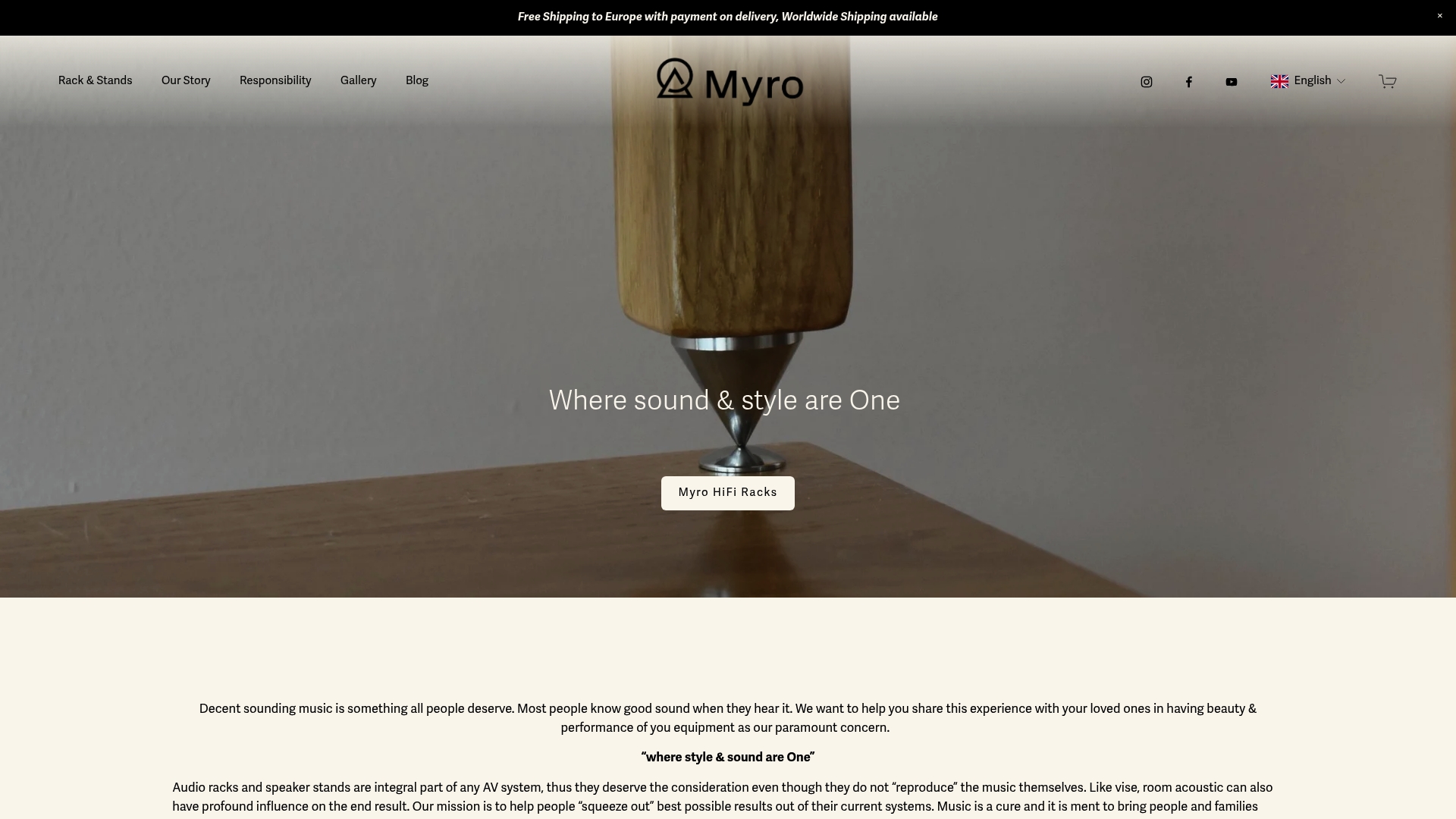
If what we have covered here resonates with how you think about your system, we invite you to explore solid wood racks and see the full range for yourself. Our Myro Racks & Stands combine heavy isolation spikes, natural hardwood shelving, and clean design that sits confidently in any serious listening room. Visit hifi-rack.com to find the rack that fits your setup, your ears, and your values.
Frequently asked questions
What makes YAKUSUGI cedar unique for audio applications?
YAKUSUGI cedar is over 2,000 years old with extremely tight grain and high resin content, producing an organic, sensual sound that no farmed or younger wood can replicate. Its natural density makes it one of the most effective vibration-damping wood materials in premium audio components.
Are agricultural fiber panels good for high-end studio use?
Coconut and sugarcane fiber composites deliver strong sound absorption across the mid-to-high frequency range, making them excellent for room treatment walls and ceiling panels, though they are rarely used in high-precision component bodies where material consistency is more critical.
Is cork as effective as wood for Hi-Fi vibration control?
Cork is highly effective at damping mechanical vibrations and is widely used in rack feet and speaker bases, but as performance data suggests, it is best applied in enclosures and isolation roles rather than in signal-path components where premium hardwoods still set the acoustic standard.
How do I balance performance and sustainability with my material choices?
Use high-performance natural materials like dense hardwood or aged cedar for the components and surfaces that are most acoustically critical, and apply recycled or rapidly renewable materials such as bamboo, cork, or fiber composites for structural and treatment roles where the sonic trade-offs are minimal.