
You can spend five figures on a turntable, amplifier, and speakers, and still fall short of what your system is actually capable of delivering. The missing variable is almost always the furniture holding your equipment. Most audiophiles treat their rack or stand as an afterthought, a shelf to park gear on rather than a critical component in the signal chain. Traditional craftsmanship changes that equation entirely. Handcrafted audio furniture, built from solid hardwoods using time-tested joinery techniques, actively contributes to sonic performance while bringing lasting visual integrity to your listening room.
Table of Contents
- Handcrafted furniture: Beyond aesthetics and build quality
- Acoustic advantages: Empirical proof of better sound
- Features that matter: Mass, rigidity, and vibration control
- How to select the right handcrafted audio furniture
- Why mainstream advice misses the mark: The hidden value of tradition
- Discover handcrafted audio furniture solutions
- Frequently asked questions
Key Takeaways
| Point | Details |
|---|---|
| Durability and longevity | Handcrafted audio furniture is built to last decades, often becoming heirloom pieces. |
| Acoustic performance boost | Dense, well-made racks reduce vibration and improve sound clarity for audiophile systems. |
| Integrated home aesthetics | Traditional craftsmanship harmonizes with both modern and vintage decor, enhancing your space. |
| Feature-focused selection | Prioritize mass, rigidity, and vibration absorption for the best listening experience. |
Handcrafted furniture: Beyond aesthetics and build quality
There is a meaningful difference between furniture built to look good in a showroom photograph and furniture built to last half a century in a serious listening room. Handcrafted audio racks fall firmly into the second category. When a craftsman selects a solid walnut or cherry slab, he is choosing a material that will harden and stabilize over time rather than degrade, warp, or delaminate like the MDF (medium-density fiberboard) found in most mass-produced alternatives.
Solid wood construction enables what collectors call heirloom quality. These pieces accumulate character rather than wear. The grain deepens, the finish mellows, and the structure remains as rigid as the day it was assembled. That kind of longevity is not just satisfying to own. It also means the acoustic properties you are paying for remain consistent for decades. As noted in coverage of high-end audio furniture design, handcrafted furniture enhances aesthetics, integrating seamlessly as heirloom pieces that complement home decor while outperforming disposable mass-produced units in durability.
What sets handcrafted racks apart from their factory-produced counterparts?
- Material integrity: Solid hardwoods provide consistent density and grain structure, both of which matter for vibration damping and resonance control.
- Joinery precision: Mortise-and-tenon or dovetail joints create connections that tighten over time, unlike the cam-lock fittings in flat-pack furniture that loosen with use.
- Finish quality: Hand-applied oil or wax finishes penetrate the wood grain rather than sitting on top of it, protecting the structure without adding acoustic coloration.
- Visual continuity: A well-chosen rack in walnut, ash, or oak integrates with vintage turntable setups, modern minimalist rooms, and everything in between, without looking like it arrived from a big-box store.
"The rack is not a neutral surface. It is a participant in the playback chain, and the material it is made from determines how actively or passively it participates." This is a perspective we hold deeply, and it is one that serious listeners increasingly share.
You can browse pieces that demonstrate this philosophy directly through our audio furniture gallery, where you will see how visual design and acoustic function are treated as inseparable in every build.
With aesthetics and durability in mind, let's examine how craftsmanship translates directly to sonic performance.
Acoustic advantages: Empirical proof of better sound
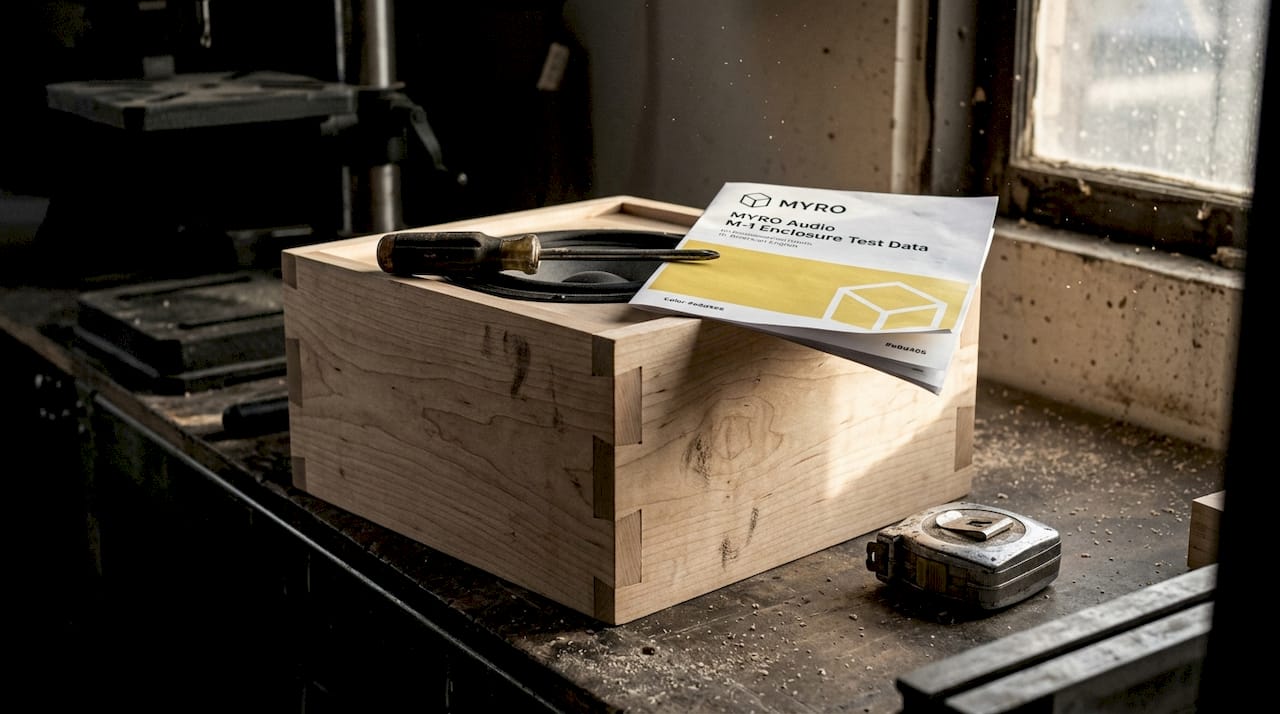
The claim that furniture affects sound quality is not anecdotal. It is testable, and it has been tested. Controlled anechoic chamber experiments (conducted in rooms specifically designed to eliminate reflected sound so that only direct output is measured) consistently show that the cabinet or enclosure material surrounding audio equipment influences what you hear.
Research on birch wood enclosures with filling demonstrates measurable benefits: birch wood reduces low-end boom by 8 dB and smooths frequency response by 2 dB across the listening range. These are not subtle adjustments. An 8 dB reduction in unwanted low-frequency resonance is the kind of change you would hear clearly on the first track you play.
| Material | Low-end resonance reduction | Frequency response improvement |
|---|---|---|
| Birch wood (filled) | 8 dB | 2 dB |
| Generic MDF | Minimal | Negligible |
| Solid hardwood (walnut/oak) | Significant | Measurable |
| Plastic/metal composites | None or negative | Variable |
The underlying mechanism involves the way dense, fibrous wood grain scatters and absorbs vibrational energy rather than transmitting it cleanly to your equipment. When a speaker driver moves air, it also moves the floor, and that energy travels upward through your rack into your turntable, preamplifier, or DAC. A mass-produced rack made from thin particleboard amplifies certain frequencies as it resonates. A solid wood rack, especially one with sufficient mass and proper joinery, absorbs that energy and dissipates it as negligible heat rather than audible distortion.
Statistic callout: An 8 dB reduction in low-end boom is equivalent to cutting unwanted bass resonance by more than half in perceived loudness terms, a transformation most listeners describe as the system suddenly "snapping into focus."
Pro Tip: If you are hearing a consistent low-frequency muddiness regardless of how you adjust your equalizer or speaker positioning, your rack is almost certainly the culprit. Try placing a heavy book on each shelf and listening again. If the bass tightens, you need more mass in your rack's construction.
Understanding the science of acoustic isolation in greater depth is worth the time. Our acoustic isolation guide walks through the physics clearly and connects it to practical rack selection criteria.
Armed with objective test data, let's explore the specific features and practical impacts of traditional audio furniture construction.
Features that matter: Mass, rigidity, and vibration control
Three physical properties determine how much an audio rack contributes to, or detracts from, sonic performance: mass, rigidity, and vibration absorption capacity. Handcrafted solid wood racks excel in all three. Mass-produced alternatives typically compromise on all three to hit a price point.

Mass prevents sympathetic vibration. When a speaker cone moves air at 60 Hz, that energy propagates through every surface in the room. A lightweight rack vibrates in sympathy with those frequencies, introducing micro-movements into your turntable's stylus or your preamplifier's tubes. A heavy rack, particularly one built from dense hardwood with thick shelves, simply does not move in response to those forces. Expert reviews consistently praise wooden craftsmanship racks for mass, rigidity, and vibration absorption, elevating sonic performance over generic furniture.
Rigidity ensures that each shelf remains a stable, level platform regardless of the weight placed on it or the vibrations traveling through the structure. Traditional joinery, where pieces of wood interlock mechanically rather than relying on adhesive or hardware alone, creates a rack that functions as a unified structure rather than a collection of panels held together by screws.
Vibration absorption is where wood truly outperforms metal and plastic. Wood's cellular structure, those irregular pathways of fibers and grain, scatters vibrational energy in multiple directions simultaneously, converting kinetic movement into an amount of thermal energy too small to register. Metal transmits vibration efficiently. That is useful for guitar strings. It is counterproductive in an equipment rack.
Here is how traditional and mass-produced racks compare across the criteria that matter most:
| Feature | Traditional handcrafted rack | Mass-produced rack |
|---|---|---|
| Shelf material | Solid hardwood (20mm+) | Particleboard or MDF (12-15mm) |
| Joinery | Mortise-and-tenon, dovetail | Cam-lock fittings, screws |
| Mass per shelf | High (5-10 kg typical) | Low (1-3 kg typical) |
| Vibration absorption | Excellent | Poor to moderate |
| Lifespan | 50+ years | 5-10 years |
| Acoustic coloration | Low and predictable | Variable and unpredictable |
When evaluating any rack for your system, we recommend working through these steps in order:
- Assess shelf thickness. A shelf under 20mm in solid wood will flex under heavy amplifier loads, reducing both rigidity and vibration control.
- Test for resonant frequency. Knock on an empty shelf. A dull thud indicates good mass and damping. A hollow ring indicates a problem.
- Examine the joinery. Look for mechanical interlocks at corners and shelf supports rather than exposed screw heads or cam locks.
- Weigh the rack. Mass is not cosmetic. If a rack feels light when you pick it up, it will behave lightly under acoustic load.
- Verify spike or footer design. Heavy spikes decoupled from the floor prevent vibration transmission from the structure below, and this is especially important on suspended wooden floors.
Pro Tip: Before purchasing, ask the manufacturer or retailer for the exact wood species and shelf thickness. If they cannot provide those details readily, that is a reliable indicator of mass-production origins regardless of how the piece is marketed.
Our solid wood rack guide provides a thorough breakdown of species-specific acoustic properties, and our resource on creating premium audio spaces addresses room integration holistically.
Understanding these features empowers you to make practical decisions. Now let's see how to evaluate and select handcrafted solutions.
How to select the right handcrafted audio furniture
Choosing the right handcrafted rack or stand requires more than finding something that fits your equipment dimensions. The best selection balances acoustic performance, room integration, and long-term suitability for your specific system. As handcrafted racks integrate aesthetic and sonic benefits, they represent a fundamentally different proposition than disposable units for discerning listeners.
Start your evaluation with these criteria:
- Wood species: Walnut and oak offer excellent density and damping. Cherry and ash provide slightly different tonal characteristics, with ash tending toward a tighter midrange. Birch, as the anechoic chamber data confirms, performs outstandingly in vibration-heavy environments.
- Construction method: Look for evidence of traditional joinery. Continuous grain at corners (where the grain wraps around a joint) indicates solid wood rather than veneer over composite.
- Vibration control features: Adjustable heavy spikes, isolation feet, or shelf decoupling platforms indicate that the builder has thought about acoustic performance, not just visual presentation.
- System matching: A single-box integrated system needs different support than a multi-component setup with a separate phono stage, amplifier, and DAC. Map out your current and anticipated system configuration before selecting shelf count and load ratings.
- Room acoustics: A well-chosen rack in the wrong position can negate its acoustic advantages. Place the rack away from corners where bass accumulates, and ensure it sits on the most stable part of your floor.
- Avoiding the price trap: High price does not automatically indicate quality. Some manufacturers apply premium pricing to MDF frames with decorative veneers. Verify material specifications independently before purchasing.
Custom and limited-edition pieces deserve serious consideration. When a craftsman builds to your specifications, using wood chosen for your room's acoustic profile and your system's load requirements, you receive furniture that functions as a tuned component rather than a generic support structure. The investment compounds over time because the piece does not depreciate in the way mass-produced alternatives do.
Understanding why natural materials matter for acoustic performance will sharpen your evaluation skills considerably, and detailed speaker stand setup tips address the often-neglected question of stand height and decoupling method.
Now that you have seen how to select handcrafted racks, let's consider what most guides overlook: the long-term impact and cultural value.
Why mainstream advice misses the mark: The hidden value of tradition
Most buying guides in the audio space focus on specifications, component measurements, and price-to-performance ratios. That framework works reasonably well for electronics, where objective measurements correlate tightly with audible performance. It fails almost completely when applied to audio furniture, and that failure costs listeners real satisfaction over time.
The conventional recommendation is to spend as little as possible on a rack and put the savings into electronics. We understand the logic. We disagree with the conclusion. Here is why.
A solid wood rack from a traditional craftsman is not a passive shelf. It is an acoustically active component that shapes how your electronics perform in your specific room, with your specific floor, in the presence of your specific speaker output. Its behavior is not fixed at the factory like a resistor value. It evolves as the wood settles and the joints tighten, typically improving over the first few years of use. Mass-produced alternatives do not improve. They degrade.
There is also the question of what we might call acoustic identity. Your listening room is not a measurement lab. It is a space where you spend hours, possibly decades, connecting with recorded music. The furniture in that space shapes how that experience feels in ways that go beyond frequency response graphs. A beautifully crafted walnut rack with a hand-rubbed oil finish changes how you relate to your system. You handle your records more carefully. You make more deliberate listening choices. The quality of the object around you elevates the quality of attention you bring to the music.
This is not nostalgia. It is a real and documented relationship between our material environment and our perceptual engagement. Mainstream advice ignores it because it cannot be easily measured. We think that is a significant omission. Our audiophile solid wood guide explores this connection between material quality and listening culture in greater depth.
Traditional craftsmanship also preserves a form of knowledge that is genuinely at risk. Four-generation woodworking heritage is not a marketing claim. It represents accumulated understanding of how wood behaves, how joints age, and how acoustic properties shift with humidity and temperature cycles across decades. That knowledge does not live in a data sheet. It lives in the hands and judgment of craftsmen who have worked with these materials long enough to understand them at a level that no manufacturing process can replicate.
Discover handcrafted audio furniture solutions
The research is clear, and the craftsmanship tradition is real. If you are ready to match your audio furniture to the standard of your electronics, we have put together a curated collection that reflects everything discussed here: responsible hardwood selection, traditional joinery, acoustic performance by design, and visual integrity that belongs in a serious listening room.
Browse our full range of shop solid wood HiFi racks to find pieces matched to your system's scale and your room's aesthetic. If you are specifically looking at integrated rack and stand solutions, our Myro racks & stands collection offers some of our most refined work in this area. For listeners with specific requirements around shelf count, load rating, or wood species, our custom handmade racks service lets us build exactly what your system needs.
Frequently asked questions
What makes handcrafted audio racks superior to mass-produced furniture?
Handcrafted racks use premium solid hardwoods and traditional joinery to deliver superior vibration control and acoustic damping, and as research confirms, they outperform disposable units in both durability and sonic contribution. The result is a stable, long-lasting platform that actively improves your system's performance rather than simply housing it.
How do wood types affect acoustics in audio furniture?
Dense woods scatter and absorb vibrational energy through their irregular grain structure, and birch wood enclosures with filling reduce low-end boom by 8 dB while smoothing frequency response by 2 dB. Species like walnut, oak, and ash each bring distinct damping characteristics that suit different system profiles and room conditions.
Can handcrafted racks fit modern decor as well as vintage?
Yes, and this versatility is one of their strengths. As design reviews note, handcrafted furniture integrates seamlessly with both contemporary and vintage setups because natural wood grain and traditional proportions complement a wide range of interior styles.
What specific features should audiophiles look for?
Prioritize mass, rigidity, shelf thickness above 20mm, and adjustable spike footers for floor decoupling. Expert reviews confirm that wooden craftsmanship racks with these properties consistently outperform generic furniture across all measurable acoustic criteria.