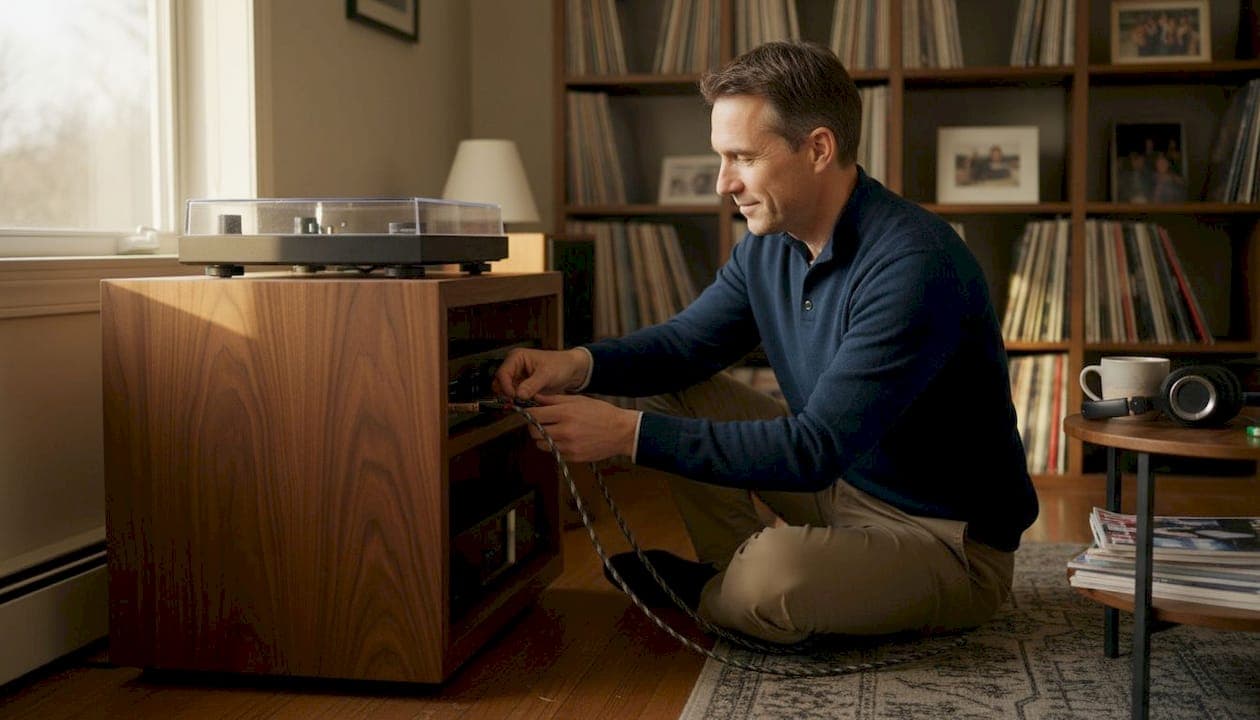
Not all wood is created equal, and for audiophiles who care about both the look and the sound of their listening space, that distinction matters enormously. The phrase "furniture-grade wood" gets thrown around constantly in product listings and marketing copy, but very few sellers explain what it actually means or why it affects your audio setup. We want to change that. Understanding furniture-grade standards, from grading methodology to species selection, gives you a real edge when choosing Hi-Fi racks, speaker stands, and equipment platforms that perform as beautifully as they look.
Table of Contents
- Defining furniture-grade wood for audio furniture
- How grading affects acoustic performance and longevity
- Comparing top wood types for audio furniture
- Selecting the right furniture-grade wood for your Hi-Fi setup
- The overlooked value of true furniture-grade wood in audio setups
- Elevate your sound and space with premium Hi-Fi furniture
- Frequently asked questions
Key Takeaways
| Point | Details |
|---|---|
| Clear grading standards | NHLA grading ensures wood for audio furniture meets high standards of clarity, appearance, and consistency. |
| Acoustic performance matters | Properly graded and kiln-dried wood helps maintain superior sonic qualities and long-term stability. |
| Species impact sound | Choices like birch, maple, or walnut influence both the look and the sound of your Hi-Fi setup. |
| Documentation adds confidence | Requesting NHLA or kiln-drying paperwork gives assurance of authenticity for premium purchases. |
Defining furniture-grade wood for audio furniture
With that context, let's clarify exactly what makes a piece of wood "furniture-grade" and why this matters for audio furniture specifically. The term is not arbitrary, and it is not simply a marketing phrase that manufacturers attach to any piece of decent-looking timber.
In North America, the most authoritative standards come from the National Hardwood Lumber Association (NHLA). Their grading methodology evaluates boards based on the percentage of "clear cuttings," meaning sections of the board that are free from defects like knots, splits, checks, and streaks. At the top of the hierarchy, FAS grade requires the largest defect-free areas, specifically clear sections measuring at least 4 by 5 inches or 3 by 7 inches, with the board yielding a very high percentage of clear material. Select grade allows slightly smaller boards (4 by 6 inches minimum) with at least 83% clear material on the better face. Moving down the scale, #1 Common requires 66.67% clear yield, and #2 Common drops to 50% clear yield.
Why does this matter for your Hi-Fi rack or speaker stand? Because defects are not just visual problems. A knot or check in the wood creates an inconsistency in density, and that inconsistency can translate into unpredictable acoustic behavior. For audio furniture, you want materials that behave consistently across the entire structure.
| NHLA Grade | Minimum clear yield | Best audio application |
|---|---|---|
| FAS | ~83-100% | Visible panels, top shelves |
| Select | 83% (one face) | Speaker stands, side panels |
| #1 Common | 66.67% | Internal structural components |
| #2 Common | 50% | Non-visible framing only |
Beyond structural consistency, furniture-grade prioritizes appearance and finishability over raw strength alone. This is critical for visible components like racks and stands where the finish you achieve directly affects the perceived quality of your entire listening room. Uniform color, minimal knots, and a smooth grain that accepts stains and oils evenly are all characteristics that define truly furniture-grade material.
Key visual and tactile signs of furniture-grade wood include:
- Consistent color tone across the board face with no dramatic streaking
- Tight, even grain patterns that indicate controlled growth and density
- Smooth surfaces that require minimal sanding to achieve a fine finish
- Absence of large knots, checks, or end splits
Understanding why natural materials matter for HiFi audio furniture helps frame why these visual and structural standards directly connect to the performance of your system.
Pro Tip: Always ask sellers for documentation of their grading compliance before purchasing. A reputable craftsman or supplier should be able to tell you the NHLA grade of the wood they are using, not just describe it vaguely as "solid wood" or "premium hardwood."
How grading affects acoustic performance and longevity
Now that grading is clear, let's see why it matters beyond appearances, especially for audio performance and durability over the long term.
One of the most underappreciated qualities of high-grade solid hardwood is how it ages. Unlike engineered alternatives, solid hardwoods develop a richer patina over years of use. This is not just aesthetically pleasing for audiophiles who value authenticity; it is a sign that the wood is alive in a material sense, responding to its environment while maintaining structural integrity. That character is something engineered sheet goods simply cannot replicate.
"Solid hardwoods offer superior patina and longevity compared to engineered alternatives, but they require proper kiln-drying to prevent wood movement that can impact acoustic stability over time."
Wood movement is a real concern for audio furniture. When wood is not properly dried before milling, it continues to release moisture, causing warping, twisting, or cupping. On a Hi-Fi rack or speaker stand, even minor warping changes contact points between components, disrupts the isolation geometry, and introduces DISTURBANCES that your equipment and ear can detect. Kiln-drying brings moisture content down to a stable level (typically 6 to 8 percent for furniture applications), locking the wood into a dimensionally stable state.
Here is how to practically check for quality drying and high grading before you buy:
- Ask for moisture content data. Reputable suppliers measure and record moisture content after kiln-drying. The target for indoor furniture is 6 to 8 percent.
- Check end grain sealing. Properly dried boards often have their ends sealed to prevent rapid re-absorption of moisture during storage.
- Look for flat boards. Hold the board at eye level and sight along the length. Any bowing or cupping indicates inadequate drying or poor storage.
- Feel for uniform surface texture. Inconsistent texture can signal areas of higher moisture content that dried at different rates.
- Request species-specific documentation. Different species move differently; knowing the species helps predict long-term stability.
For audiophiles building or buying a serious listening setup, our solid wood HiFi rack guide covers these material factors in detail alongside practical product recommendations. And if you are thinking bigger about your room environment, ideas for creating premium audio spaces include furniture selection as a foundational element.
Pro Tip: Avoid placing untreated or poorly graded wood platforms directly under sensitive analog equipment like turntables or DACs. The risk of micro-warping and inconsistent damping is real, and it costs you in sonic clarity.
Comparing top wood types for audio furniture
To make smart choices, it's helpful to look at how different acclaimed "furniture-grade" woods actually perform in audio setups. Species selection is just as important as grading, because even a perfectly graded board behaves differently depending on the species.
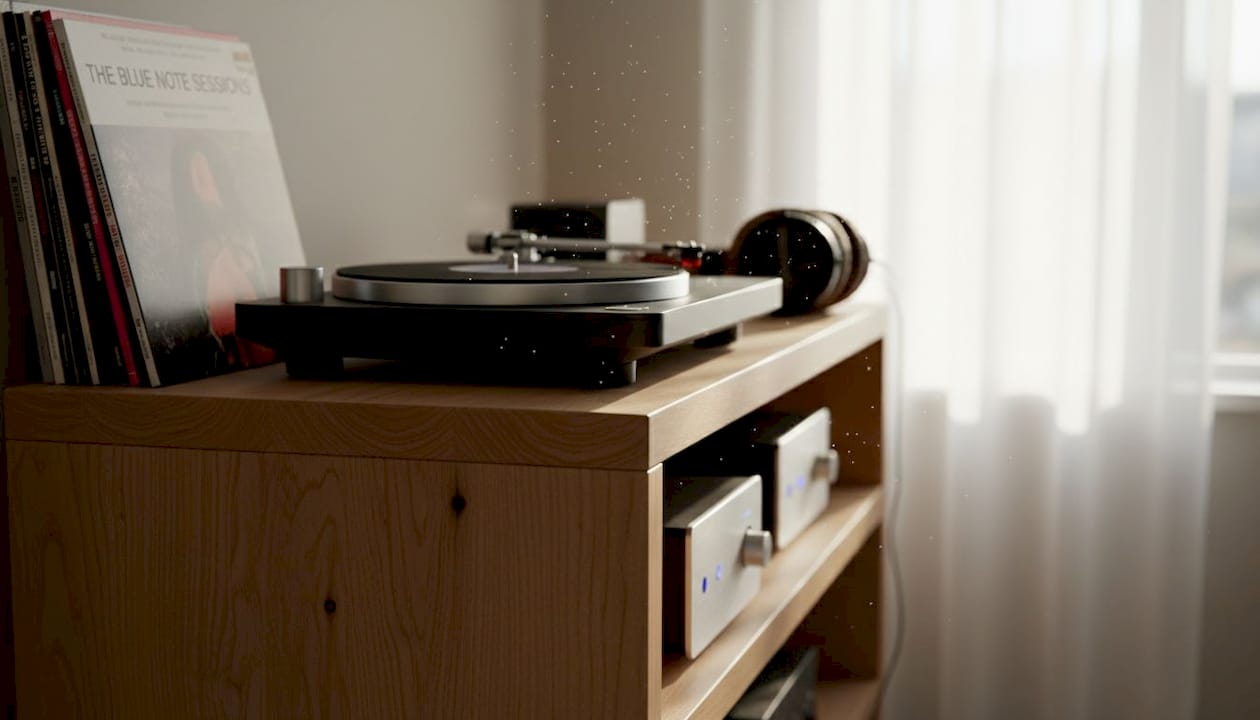
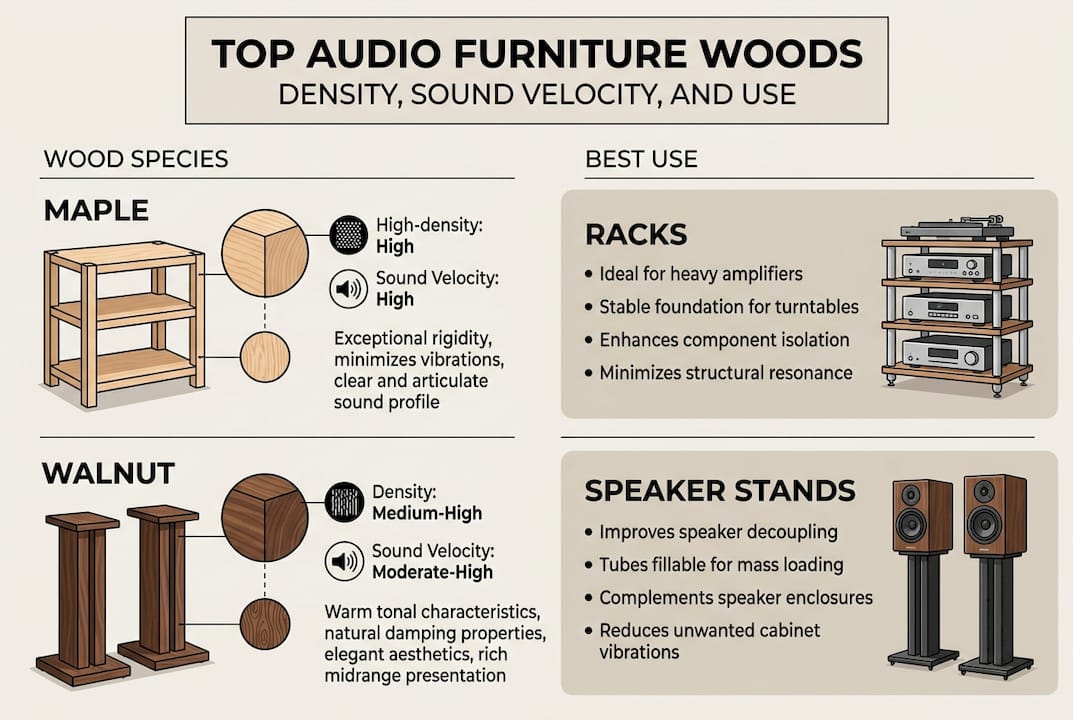
The speed of sound through a material and its internal damping coefficient are the two most important acoustic parameters for audio furniture. For reference, useful wood species for audio applications fall in the density and sound velocity range of approximately 3300 to 3800 meters per second, which gives them a good balance between transmission and damping. Birch, in particular, shows impressive results in controlled studies: birch enclosures demonstrate smoother frequency response with proper filling, including an 8 dB reduction in bass boom compared to unfilled alternatives.
| Wood species | Density (kg/m³) | Sound velocity (approx. m/s) | Damping quality | Best use case |
|---|---|---|---|---|
| Birch | 600-670 | 3500-3700 | Medium-high | Shelving, enclosures |
| Maple | 630-755 | 3700-3900 | Medium | Rack frames, platforms |
| Walnut | 590-650 | 3200-3500 | High | Stands, aesthetic panels |
| Oak | 640-720 | 3400-3600 | Medium | Structural frames |
| Cherry | 550-630 | 3100-3400 | High | Decorative and functional |
Engineered woods like MDF and birch plywood are sometimes marketed as furniture-grade and do meet certain appearance standards. They offer dimensional stability and consistent density, which sounds appealing on paper. The trade-offs, however, are significant for serious listeners. Engineered boards lack the unique cellular structure of solid hardwood that contributes to natural damping of specific resonant frequencies. They also cannot develop patina, they often require veneer to look presentable, and they respond poorly to humidity changes over time in ways that solid wood manages more gracefully.
Key species advantages worth knowing:
- Walnut offers high natural damping and a rich, warm aesthetic that many audiophiles find perfectly aligned with the emotional quality of their listening experience
- Maple is exceptionally hard and dense, making it excellent for platforms under heavy amplifiers where rigidity matters
- Birch works well for shelving because its relatively consistent ring structure gives predictable acoustic behavior
- Cherry is softer than maple but has outstanding finish acceptance and deepens beautifully in color over years of exposure to light
Good audio rack isolation starts with the right material choice, because no spike or footer can fully compensate for a poorly chosen wood platform underneath your equipment.
Selecting the right furniture-grade wood for your Hi-Fi setup
With all the facts in hand, here's how you can confidently put this knowledge to use for your next Hi-Fi furniture purchase. The goal is not just to buy something that looks good on day one. The goal is to invest in furniture that performs and ages alongside your audio system, getting better rather than worse with time.
Start by verifying grading claims. When a seller describes their product as using "premium solid wood," that is a vague claim. Push further. Furniture-grade prioritizes appearance and finishability alongside structural consistency, so a seller confident in their material should be happy to specify the NHLA grade, the species, the drying method, and the origin of the timber.
A practical checklist for evaluating furniture-grade wood in audio furniture:
- Origin and sourcing: Is the wood from responsibly managed forests? FSC certification is a strong positive indicator.
- NHLA grade documentation: Can the seller provide the grade designation (FAS, Select, etc.)?
- Kiln-drying confirmation: Was the wood kiln-dried, and to what moisture content?
- Species specification: Is the species clearly identified, not just described as "hardwood"?
- Finish type: Is the finish an oil, lacquer, or wax that allows the wood to breathe and develop character?
- Construction method: Is the joinery solid (mortise and tenon, dovetail) or just butt joints with fasteners?
- Visible grain match: On multi-piece tops or panels, do grain patterns flow logically, indicating careful selection?
Understanding what makes a good HiFi rack involves all of these material considerations alongside the mechanical design of the rack itself. You cannot fully separate one from the other.
Visual inspection is your best tool when you can handle the piece in person. Look at the end grain to understand how the board was cut (quarter-sawn boards are more dimensionally stable than flat-sawn). Check corners and edges for sharp, clean lines without filler or excessive finishing compound used to hide imperfections in lower-grade material. And look at the underside or interior; a craftsman using true furniture-grade wood rarely cuts corners where you cannot immediately see.
For visual inspiration and to understand what premium audio furniture actually looks like in a real listening environment, the audio furniture gallery gives you a genuine reference point rather than stylized product photography.
Pro Tip: Prioritize pieces with full NHLA documentation and a clear species callout. If a seller cannot or will not provide this, that tells you something important about the material they are using.
The overlooked value of true furniture-grade wood in audio setups
Having laid out the practical details, let's shift perspective to what most guides miss, where long-term value and sonic experience genuinely converge.
We see a lot of audiophiles spend serious money on electronics and then cut corners on furniture, treating the rack or stand as a secondary concern. That is a mistake we think comes from a misunderstanding of how vibration and resonance actually work in a listening room. Your equipment does not exist in isolation. It sits on a surface, and that surface is either helping or hurting the signal chain.
True furniture-grade wood, properly selected and crafted, is not just a visual upgrade. It is an acoustic decision. The subtle coloration that a poorly damped MDF shelf adds to your midrange is the kind of thing you may not notice until you replace it, and then you cannot unhear it. We have seen this again and again. Audiophiles who invest in proper solid hardwood furniture for premium audio space ideas consistently report a cleaner, more focused soundstage, often without changing a single component in their system.
The mass market has commoditized the word "furniture-grade" to the point where it has almost lost meaning. We think it is worth insisting on the real thing, because the long-term value of a well-made solid hardwood rack, one that will not warp, will develop character, and will still perform in twenty years, far outweighs any short-term savings from lesser materials. Craftsmanship is not a luxury add-on. For serious listeners, it is part of the system.
Elevate your sound and space with premium Hi-Fi furniture
If you're inspired to upgrade your own setup with authentic furniture-grade wood, here's how you can start.
At hifi-rack.com, every rack and stand we offer is built from high-grade solid hardwoods, sourced responsibly and crafted with four generations of woodworking knowledge behind every joint. We do not use vague descriptions. We tell you the species, the finish, and the construction method because we believe you deserve that transparency. Browse our full shop Hi-Fi racks collection to see what furniture-grade really looks like in practice. If you want something tailored precisely to your system and space, explore custom HiFi racks options or take a closer look at the Myro Racks & Stands line as a starting point.
Frequently asked questions
What does 'furniture-grade' mean in wood?
"Furniture-grade" refers to wood that meets high appearance, uniformity, and finish standards, with NHLA grading evaluating boards based on the percentage of clear, defect-free cuttings across the board face.
Why is kiln-drying important for audio furniture wood?
Kiln-drying stabilizes moisture content and prevents the wood movement that would otherwise compromise both structural integrity and acoustic isolation; solid hardwoods require this step to deliver reliable long-term performance under audio equipment.
Which wood species are best for audiophile furniture?
Birch, maple, and walnut are consistently favored because their density and sound velocity characteristics of approximately 3300 to 3800 meters per second provide excellent vibration damping alongside outstanding finish quality.
Do engineered woods qualify as furniture-grade?
Some engineered woods meet appearance grading standards but solid hardwoods offer superior acoustic damping, patina development, and long-term structural behavior that engineered sheet goods fundamentally cannot replicate.
How can I verify if a product uses true furniture-grade wood?
Ask the seller directly for NHLA grade documentation, species identification, and kiln-drying confirmation; NHLA compliance ensures consistency and gives you a concrete benchmark rather than relying on vague marketing language.