Choosing audio furniture is one of the most consequential decisions you'll make for your listening room, and it's also one of the most overlooked. Most audiophiles invest heavily in amplifiers, DACs, and speakers, then drop their components onto a generic shelf and wonder why the system never sounds quite right. The reality is that furniture actively participates in your system's sonic performance. Getting it right means balancing vibration control, material density, room acoustics, and visual design all at once. This checklist gives you a structured, practical blueprint so you can make every purchase count.
Table of Contents
- Key criteria for selecting audio furniture
- Essential audio furniture items for your setup
- Comparison: Popular audio furniture features
- Situational recommendations: Matching furniture to your listening space
- Why most audio furniture checklists fall short
- Upgrade your listening space with premium audio furniture
- Frequently asked questions
Key Takeaways
| Point | Details |
|---|---|
| Furniture impacts sound | Choosing the right audio furniture greatly influences your system's performance and room acoustics. |
| Material and placement matter | Dense, well-placed furniture controls vibrations and unlocks better clarity and depth. |
| Tailor to your space | Match your audio furniture to your listening room size, style, and system needs for the best results. |
| Compare before you buy | Use feature comparisons and checklists to select furniture that fits both your sonic goals and your home. |
Key criteria for selecting audio furniture
With a clear understanding of why selection matters, we break down the key criteria that define truly high-performance audio furniture.
The first and most important factor is how furniture interacts with your room's acoustics. Hard, flat surfaces reflect high-frequency energy back into the listening space, creating flutter echo and smearing stereo imaging. Dense, natural materials like solid walnut or oak absorb and scatter vibrational energy at the molecular level in ways that engineered MDF or hollow metal frames simply cannot replicate. Room dimensions, floor type, and wall construction all influence which furniture choices will reinforce or undermine your investment in electronics.
Material density is closely tied to resonance damping. A rack or stand that rings or flexes under load transfers vibrational energy directly into your components, coloring the sound in ways that no equalization can fix. When we say a stand is "acoustically inert," we mean it stores and dissipates mechanical energy rather than transmitting it to the equipment above. This is why solid hardwood and sand-filled metal stands consistently outperform hollow or composite alternatives in critical listening environments.
Here are the core criteria every selection decision should pass:
- Room acoustics compatibility: Does the material absorb, scatter, or reflect sound appropriately for your space?
- Material density and rigidity: Can the piece resist resonance under dynamic loads?
- Vibration isolation method: Spikes, cones, isolation pads, or constrained-layer damping for different floor types?
- Dimensional fit: Will the piece clear your components, allow adequate airflow, and fit your room layout?
- Aesthetic coherence: Does it complement your room's design without visually dominating it?
- Cable routing provisions: Are there integrated paths for signal and power cables?
- Weight capacity: Can it safely support your heaviest components, including power amplifiers?
- Future flexibility: Can shelving be reconfigured as your system evolves?
Proper creating premium audio spaces planning addresses all of these before a single piece of furniture is purchased.
"Good furniture selection is not about aesthetics first. It's about solving acoustic and mechanical problems first, and then letting the aesthetic follow naturally. When both goals align, the result is genuinely special."
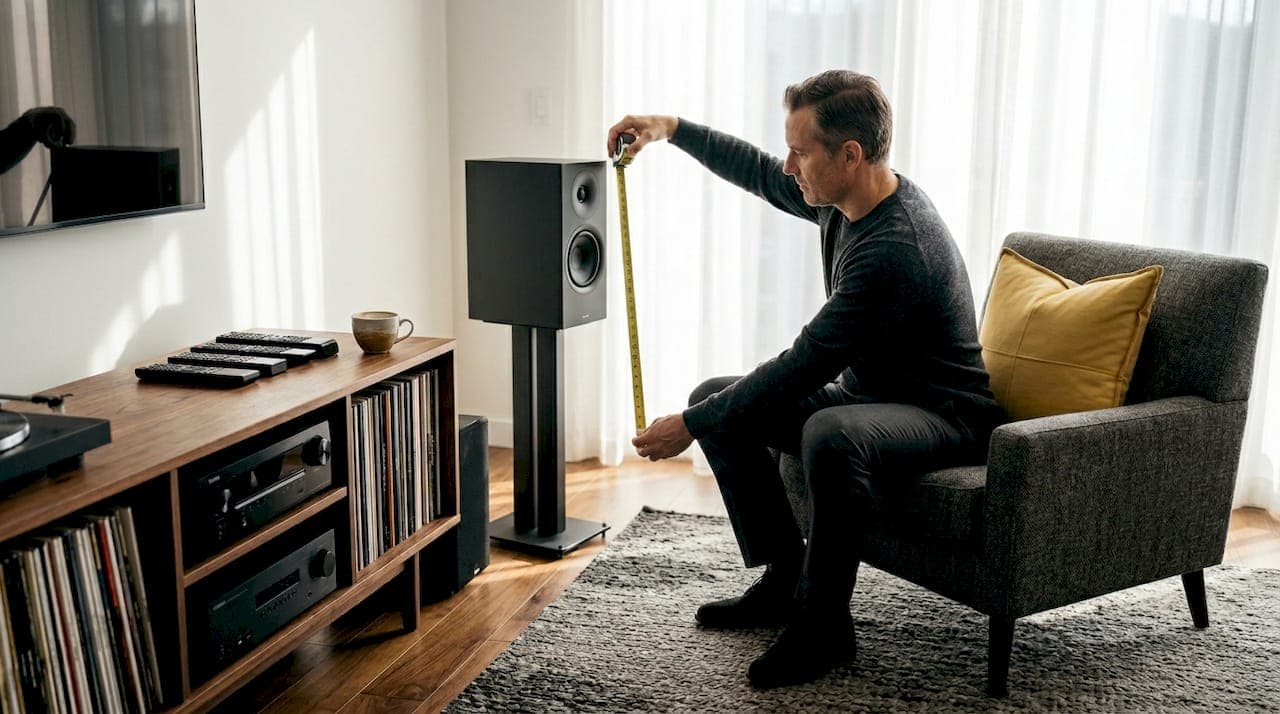
Tweeters positioned at ear height (typically 36 to 44 inches when seated) consistently deliver superior stereo imaging and detail retrieval compared to stands that place drivers below or above the listener's ear axis.
Pro Tip: Before purchasing any rack or stand, measure your seated ear height with a tape measure. Use that number as the fixed constraint when comparing stand options, not the other way around.
Optimizing audio furniture for both sound and longevity requires treating material choice and mechanical design as equally important from the start.
Essential audio furniture items for your setup
Now that you know what to look for, let's run through the fundamental furniture pieces your system absolutely needs.
Every high-performance listening room relies on the same core categories of furniture, each performing a distinct acoustic and functional role. Understanding what each piece contributes helps you allocate budget intelligently and avoid gaps that compromise the whole system.
Speaker stands are the single most acoustically sensitive piece of furniture in any system using bookshelf or standmount speakers. They determine driver height, coupling to the floor, and how much mechanical vibration travels between the floor and the speaker cabinet. Dense stands filled with sand or lead shot are dramatically more effective at damping resonance than hollow alternatives. Stands with spikes on carpet or concrete and isolation pads on wood floors represent the two most common and effective coupling strategies.
Stand checklist:
- Confirm tweeter height aligns with seated ear position (36 to 44 inches)
- Verify weight capacity exceeds speaker weight by at least 30%
- Choose fill material: sand, lead shot, or polymer damping compound
- Select correct floor interface: spikes for carpet and concrete, pads for hardwood
- Confirm base footprint is stable and proportional to speaker cabinet
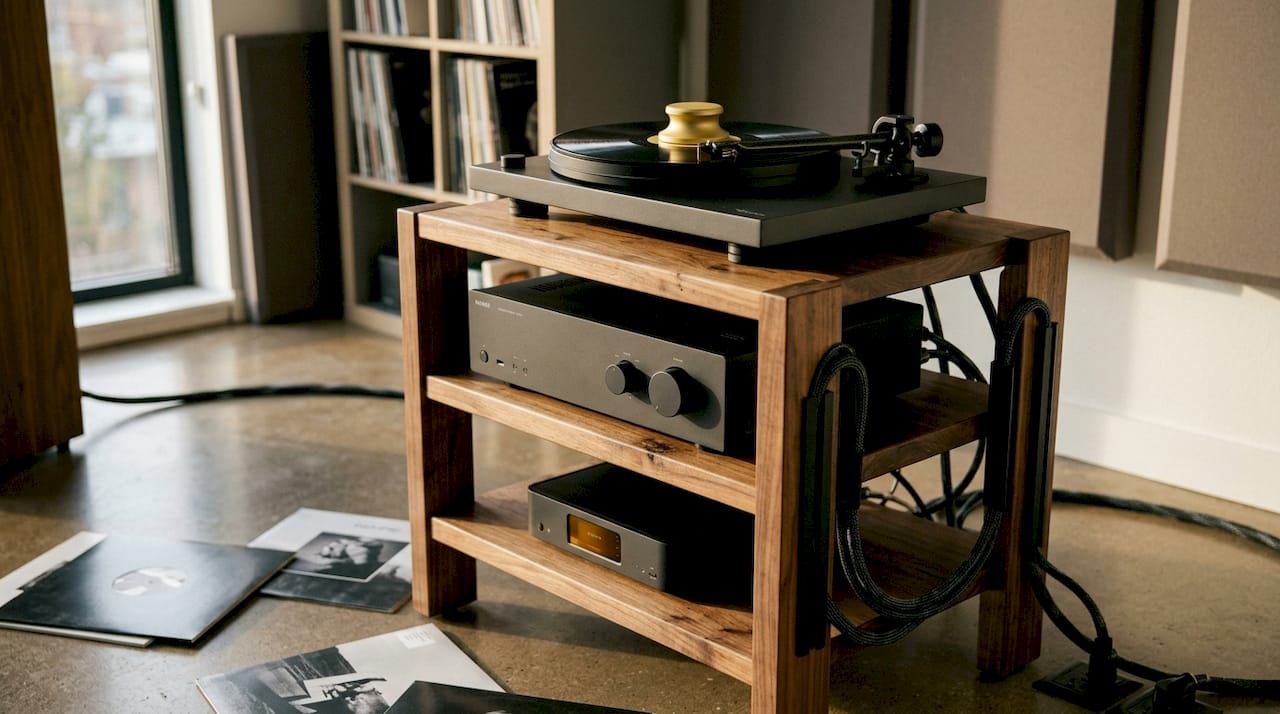
Hi-Fi racks support your source components, amplification, and power conditioning. The best racks isolate each shelf from the others so vibration from a turntable motor, for example, does not contaminate a sensitive phono stage on the shelf below. Look for best furniture types for audiophiles that feature individual shelf decoupling, solid hardwood or thick MDF shelves, and adjustable height to accommodate varying component profiles.
Rack checklist:
- Minimum of 4 to 6 shelves for a full source, preamp, power amp, and streamer stack
- Individual shelf weight rating clearly specified by the manufacturer
- Cable routing channels built into uprights or rear panels
- Leveling feet or spikes for floor coupling
- Finish that resists humidity and UV fading over decades of use
Media cabinets for vinyl, CDs, and streaming hardware need adequate airflow, especially when housing class A amplifiers or tube components that generate significant heat. Closed cabinets without ventilation shorten equipment life and can cause thermal distortion at high listening levels.
Audio seating is rarely discussed in technical guides, but fabric chairs and sofas absorb high-frequency sound energy in the listening position, softening room brightness. Leather reflects more high-frequency energy back into the room, which can be an advantage in rooms that are too acoustically dead. Position your primary seat so your ears are equidistant from both speakers and at the correct height for your stand setup.
Pro Tip: If your room is small and already quite reflective, choose fabric upholstery and consider a wool rug under your listening chair. The combination addresses room modes and flutter echo simultaneously without expensive acoustic panel installation.
Audio furniture trends increasingly favor modular systems that grow with your collection and adapt to room changes, which is an important consideration if your system is still evolving.
Comparison: Popular audio furniture features
Not all options work equally in every space. Here's a quick comparison of what matters most by category.
| Furniture type | Vibration isolation | Durability | Aesthetic flexibility | Modularity | Cable routing |
|---|---|---|---|---|---|
| Solid hardwood rack | Excellent | Very high | High | Moderate | Good |
| Steel frame rack | Good | Very high | Moderate | High | Excellent |
| Sand-filled speaker stand | Excellent | High | Moderate | Low | Basic |
| Hollow metal speaker stand | Poor | Moderate | Moderate | Low | Basic |
| Fabric seating | N/A | Moderate | Very high | N/A | N/A |
| Leather seating | N/A | High | High | N/A | N/A |
| Closed media cabinet | Poor | High | Very high | Moderate | Poor |
| Open shelving unit | Moderate | Moderate | High | High | Moderate |
The table makes clear that solid hardwood racks and sand-filled stands lead on the metrics that matter most for audio performance. Steel frame racks win on modularity, which matters if your component count is likely to grow. Hollow metal stands score poorly on isolation and should be treated as a budget compromise rather than a long-term solution.
Handcrafted furniture advantages go beyond aesthetics. The joinery methods, wood selection, and finishing processes used by skilled craftspeople produce pieces that are genuinely more acoustically stable than mass-produced alternatives, and they typically outlast them by decades.
One often-overlooked feature is modularity combined with environmental responsibility. Furniture built from responsibly sourced hardwoods and designed to be reconfigured rather than replaced represents a better long-term investment for audiophiles who upgrade regularly. It also aligns with the values many of our customers hold around sustainability and authenticity.
The environmental dimension matters more than most guides acknowledge. A rack built from sustainably harvested walnut that you keep for 20 years has a fundamentally different footprint than three consecutive budget racks replaced every few years.
Situational recommendations: Matching furniture to your listening space
Given this feature comparison, you'll want to tailor your choices to the realities of your actual space.
Room size and configuration are not just acoustic variables. They determine which furniture physically fits, what speaker stand height is achievable without blocking sightlines, and whether a freestanding rack makes more sense than wall-mounted shelving.
| Room type | Recommended rack | Speaker stand type | Seating priority | Key constraint |
|---|---|---|---|---|
| Small apartment (under 150 sq ft) | Compact 3-shelf hardwood | Low-profile filled stand | Fabric armchair | Floor space and wall distance |
| Dedicated listening room | Full 6-shelf reference rack | Full-height filled stand | Fabric sofa with headrest | Acoustic treatment integration |
| Open floor plan | Modular steel or hardwood | Mid-height stand with wide base | Fabric sectional | Diffusion and bass control |
| Loft or studio | Wall-mounted shelving | Adjustable height stand | Leather or fabric chair | Ceiling reflection management |
For small apartments, prioritize stands and racks that are narrow in footprint but dense in construction. A compact rack built from solid cherry or ash delivers superior isolation compared to a large, hollow flat-pack unit, even at the same price point. Place speakers well away from the rear wall, ideally 18 to 36 inches, to reduce bass buildup without requiring room treatment.
In a dedicated listening room, you have the freedom to optimize fully. A full-height six-shelf reference rack gives you room to expand your system, and tweeters at ear height on tall, sand-filled stands provide the most precise stereo imaging achievable with standmount speakers. This is also the environment where sustainable hardwood furniture makes the most impact, both sonically and visually.
Open floor plans are acoustically challenging because sound energy dissipates in multiple directions and bass frequencies are not reinforced by room boundaries in the same way. Choose furniture with a larger physical presence that helps define the listening zone: a substantial rack, wide-base stands, and a large fabric sofa that creates a soft rear boundary for the listening position.
Pro Tip: In open floor plans, position your listening chair with its back near a partial wall or bookshelf if possible. This creates a pseudo-rear boundary that reinforces bass and helps your brain localize the stereo image more precisely.
Sustainable audio materials offer particular advantages in modular setups because responsibly sourced hardwoods are dimensionally stable over time, meaning your rack shelves will not warp or sag even as seasonal humidity varies.
Why most audio furniture checklists fall short
Even with the best recommendations, there is one final consideration that most audiophile guides consistently overlook: context specificity. A checklist is only as good as its ability to adapt to your system, your room, and your actual listening priorities.
Generic lists treat all rooms as equivalent and all budgets as infinite. They rank products by specification sheets rather than by how those specifications interact with specific acoustic environments. A rack rated for excellent vibration isolation in a concrete-floored studio may perform very differently on a suspended timber floor in a Victorian-era home. Material properties are context-dependent. The furniture that transforms one setup can be irrelevant or counterproductive in another.
We have seen premium systems made mediocre by furniture choices that looked correct on paper. A beautifully finished solid oak rack placed directly against a rear wall, for instance, reinforces bass frequencies in ways that cloud midrange clarity, regardless of how good the rack's isolation properties are. Placement context matters as much as material quality.
The false economy of bargain shopping is another pitfall. Hollow stands purchased at a third of the cost of quality alternatives often introduce mechanical resonance that no amount of component upgrading can eliminate. We have seen customers spend thousands on electronics upgrades while continuing to use inadequate stands, then wonder why their system never reaches its potential. The furniture is the last thing they consider, when it should be among the first.
Authentic audio furniture is not about brand prestige. It is about material integrity, construction quality, and honest performance that holds up under real-world listening conditions over many years. And natural materials for audio consistently outperform synthetic alternatives precisely because their acoustic properties are the result of complex, irregular grain structures that no engineered material has yet replicated convincingly.
The most effective checklist is one you build yourself, using the criteria and categories here as a foundation, then adapting each item to your specific room, system, and long-term goals.
Upgrade your listening space with premium audio furniture
Armed with your checklist, it is time to make your setup a reality with thoughtfully designed audio furniture built to perform as well as it looks.
At hifi-rack.com, we specialize in handcrafted hardwood audio furniture made from responsibly sourced walnut, cherry, ash, and oak. Every piece is designed to solve real acoustic problems while adding genuine visual warmth to your listening room. Our racks and stands are built with heavy spikes for vibration damping, precision joinery for long-term stability, and a finish quality that ages beautifully over decades. Explore our full range at shop audio racks and stands, or browse our curated Myro racks and stands collection for designs that represent the pinnacle of our four-generation woodworking heritage.
Frequently asked questions
How high should speaker stands be for the best sound?
Speaker stands should place your tweeters at seated ear height, which is typically 36 to 44 inches for most listeners. Measure your actual ear height before selecting a stand rather than relying on generic recommendations.
Does dense furniture improve audio performance?
Yes. Dense racks and stands resist mechanical resonance, which means less vibrational energy reaches your components and more of your system's true performance comes through. Dense, filled stands consistently outperform hollow alternatives in controlled listening tests.
What is the best way to keep cables organized in an audio setup?
Use dedicated cable management channels or trays to physically separate signal cables from power cables, since parallel routing creates electromagnetic interference that degrades signal quality. Label every cable at both ends so future component changes are straightforward.
Are isolation pads or spikes better for speaker stands?
The answer depends entirely on your floor type. Spikes on carpet or concrete couple the stand rigidly to the structure below, while isolation pads on hardwood or floating floors break the mechanical connection and prevent low-frequency energy from traveling into the floor. Using the wrong option for your floor type can worsen rather than improve bass performance.