
Many audiophiles spend years chasing measurements, obsessing over THD figures and frequency response graphs, yet still feel something is missing. The real differentiator in a great hi-fi setup is rarely the last decimal point in a spec sheet. It is authenticity: honest materials, skilled craftsmanship, and furniture that was built with sonic intent. When your rack or speaker stand is made from genuine solid wood, shaped by hands that understand both joinery and acoustics, the entire listening experience shifts. This guide explores why authenticity matters across audio quality, aesthetics, and long-term satisfaction, and how you can recognize it before you buy.
Table of Contents
- Defining authenticity in hi-fi: Beyond technical specs
- Material choices: Wood, metal, and their sonic influence
- Craftsmanship and design: The role of the maker
- Authenticity, synergy, and the listening experience
- Why most hi-fi furniture misses the mark: Our perspective
- Elevate your setup with authentic hi-fi furniture
- Frequently asked questions
Key Takeaways
| Point | Details |
|---|---|
| Authenticity explained | Beyond specs, authenticity means using honest materials and real craftsmanship for hi-fi furniture. |
| Sonic and emotional impact | Solid wood and true design create both measurable improvements and a richer listening experience. |
| System synergy matters | The audible gains from authentic racks and stands depend on your full-room system synergy. |
| Choosing right | Prioritize handbuilt, verified furniture for lasting quality and enjoyment. |
Defining authenticity in hi-fi: Beyond technical specs
Authenticity in hi-fi is one of those terms that gets used loosely, so let us be specific about what we mean. In our world, authenticity covers three things: honest materials (what the furniture is actually made of, not what the label implies), genuine handcraft (how it was built and by whom), and sonic integrity (whether the design actively supports your system's performance rather than working against it).
This is where authenticity separates itself from marketing-driven "premium" claims. A rack can be finished in a rich walnut veneer, priced at a premium, and still be nothing more than MDF underneath. That is not authentic. Authentic means the walnut goes all the way through, grain and all, because the maker chose it for both its beauty and its acoustic character.
Why does this matter beyond aesthetics? Because the emotional and tactile qualities of a listening space shape how you perceive sound. When you sit down to a system housed in furniture that feels alive, that has weight and warmth and texture, your brain enters a different state. You relax. You listen more openly. Subjective warmth in audio is a real phenomenon, and it enhances immersion for serious enthusiasts in ways that a flat frequency response graph simply cannot capture.
Here are the common traps that pull audiophiles away from authenticity:
- Chasing the latest spec upgrade while ignoring resonance control in the rack
- Buying furniture based on price alone, assuming cost equals quality
- Trusting "hand-finished" marketing without asking what was actually done by hand
- Overlooking the emotional connection to the space and objects in your listening room
- Prioritizing invisible upgrades (cables, capacitors) over the foundational furniture
"The perceived warmth of a system does not live entirely in the electronics. It lives in the whole environment, the weight of the furniture, the texture of the materials, the sense that everything was made with care."
Authenticity is the difference between a system you analyze and a system you love. That distinction matters more than most enthusiasts admit.
Material choices: Wood, metal, and their sonic influence
Now that authenticity is defined, let us dig into the material choices that shape both sound and visual impact. The two dominant materials in high-end audio furniture are solid wood and metal, and each brings a distinct acoustic and aesthetic character to your setup.
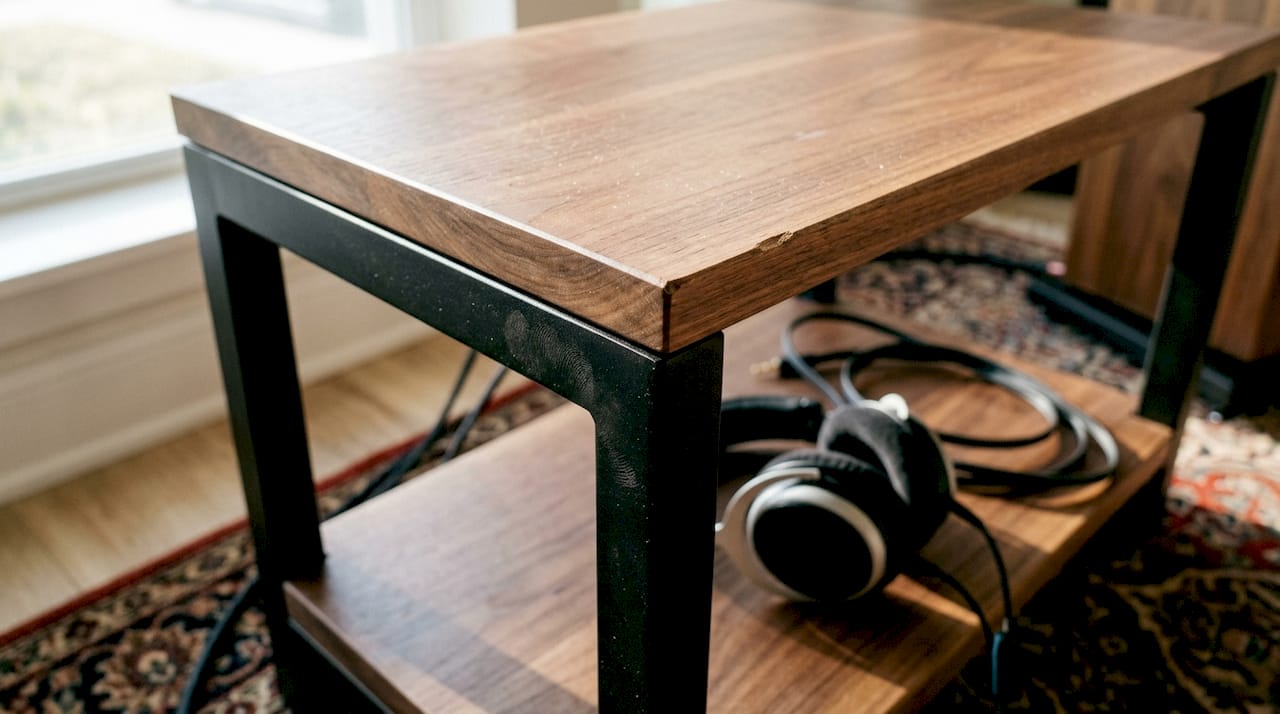
Solid wood, particularly hardwoods like walnut, cherry, ash, and oak, offers something that no engineered material fully replicates: natural damping. Wood fibers absorb and dissipate vibrational energy rather than reflecting it back into your components. This matters because turntables, CD transports, and even power amplifiers are sensitive to micro-vibrations from the floor, the room, and from each other. Wood's damping advantages can genuinely enhance perceived clarity by reducing the low-level noise floor that resonance adds to a system.
Metal, on the other hand, is extremely rigid and dimensionally stable, which makes it excellent for precise, repeatable construction. Many audiophile-grade racks use metal for structural elements, particularly shelving supports and cross-bracing, because it adds mass and stiffness where needed. The combination of solid wood shelves and metal structural elements is arguably the most effective approach, giving you the damping of wood with the stability of steel or aluminum.
| Material | Damping quality | Aesthetic character | Longevity |
|---|---|---|---|
| Solid hardwood | Excellent | Warm, natural, unique | Decades with care |
| Engineered wood / MDF | Poor to moderate | Uniform, lacks character | Limited |
| Steel / aluminum | Low (reflects vibration) | Industrial, precise | Very high |
| Veneer over MDF | Poor | Superficially premium | Shorter lifespan |
Why does genuine solid wood beat veneer for vibration control? Because veneer is essentially a decorative skin over a substrate that vibrates differently, and the mismatch between layers can actually introduce micro-resonances rather than damping them. Solid wood is consistent throughout its structure, so it behaves predictably.
Pro Tip: Before choosing a rack, think about your room as much as your gear. A hard-floored room with parallel walls already has a bright, reflective character. In that environment, a solid walnut rack does double duty, adding warmth to the system's perceived tone and anchoring the visual space.
Craftsmanship and design: The role of the maker
Materials are only part of the equation; craftsmanship defines how they come together. The difference between a handcrafted hi-fi rack and a factory-assembled one is not just pride of ownership. It is measurable in fit, finish, joinery strength, and long-term stability.
Here is what genuine craftsmanship looks like in practice:
- Wood selection at the source — A skilled maker selects each board for grain direction, density, and stability, not just appearance. Quarter-sawn boards, for example, are more dimensionally stable and are chosen deliberately.
- Traditional joinery — Mortise and tenon, dovetail, or loose-tenon joints add real structural integrity. These are not decorative; they prevent the rack from developing wobble or creak over years of use.
- Custom finishing — Oil or wax finishes that penetrate the wood preserve its acoustic properties. Thick lacquers can dampen the wood's natural resonance character and alter its behavior.
- Final hand tuning — True handcraft means the maker inspects, adjusts, and fits every joint before assembly. No two pieces are identical.
System synergy in audio is ultimately determined by the sum of every component in the chain, and furniture is part of that chain. A poorly built rack introduces variables you cannot tune out with cables or footers.
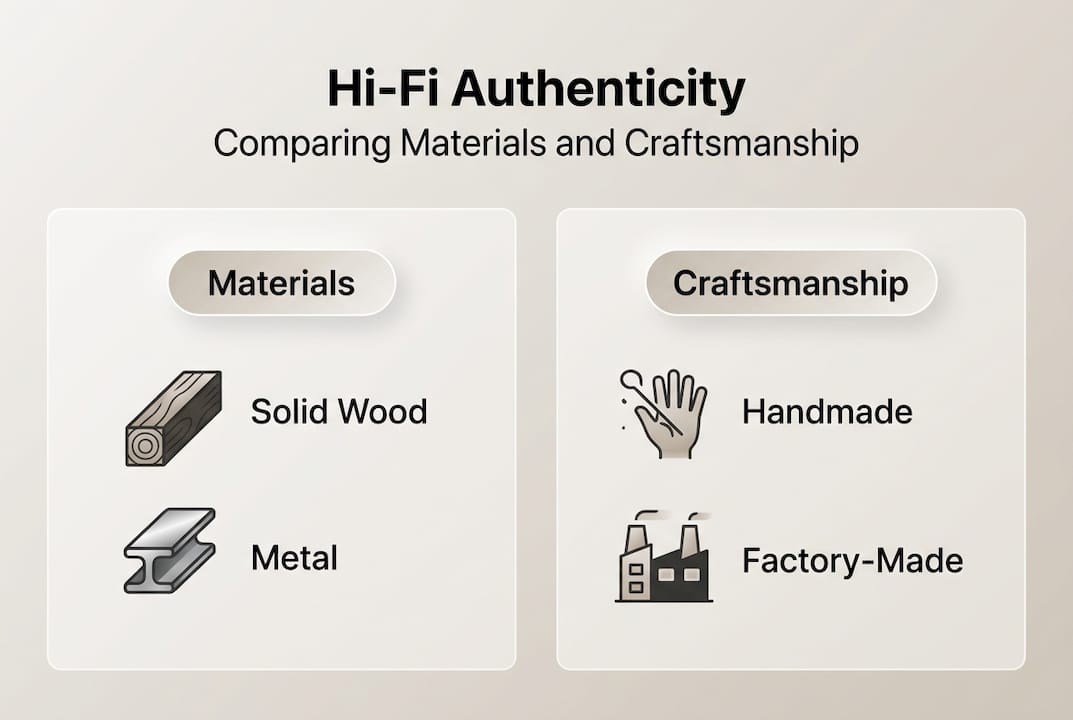
| Feature | Handcrafted piece | Factory-made alternative |
|---|---|---|
| Joinery | Traditional, tight-fitting | Cam locks and dowels |
| Wood source | Selected, sustainably sourced | Batch commodity lumber |
| Finishing | Hand-applied oil or wax | Sprayed lacquer or laminate |
| Adjustability | Custom dimensions available | Fixed sizes only |
| Lifespan | Generational | 5 to 15 years typically |
Pro Tip: When evaluating a "handcrafted" claim, ask the seller where the wood was sourced and what joinery method was used. If they cannot answer those two questions confidently, it is likely a hand-finished factory product, not a genuinely hand-built piece.
Design intent matters too. Authentic furniture is designed around the system it will hold, not designed to look good in a catalog. Shelf spacing, spike placement, and weight distribution are all deliberate choices in a properly designed hi-fi rack.
Authenticity, synergy, and the listening experience
Understanding the maker's role leads us to the heart of authenticity: how it feels and sounds in your own space. This is where everything converges. Your amplifier, speakers, turntable, and rack are not separate objects. They are a system, and the furniture is the physical foundation that either supports or undermines every other component.
In a real room, an authentic solid wood rack does several things simultaneously. It provides stable, damped support that prevents micro-vibration from traveling up from the floor into sensitive components. It contributes a warmth and naturalness to the visual and tactile environment that relaxes the listener. And it holds everything at the right height and spacing for both ergonomics and airflow.
Immersion in hi-fi is not just about measurable improvements. Empirical data supports a sense-of-place effect, where the aesthetic quality of the listening environment directly influences how engaged and satisfied listeners feel during a session. You cannot separate the room from the sound.
Signs that your setup might need an authenticity upgrade:
- Your rack wobbles or creaks when you adjust components
- The furniture looks mismatched or feels cheap relative to the electronics it holds
- You feel no emotional connection to the objects in your listening room
- Your turntable or DAC is sitting on a glass shelf with no isolation
- You find yourself listening for problems rather than enjoying the music
"Synergy is not just about matching impedances or sensitivities. It is about the whole system speaking the same language, from the cartridge to the floorboards."
This emotional dimension is what long-term satisfaction in hi-fi actually depends on. You can always find a component with better measurements. You cannot manufacture a genuine connection to a space that feels hollow or compromised.
Why most hi-fi furniture misses the mark: Our perspective
Having worked with wood for generations and built racks specifically for audiophiles, we have a clear view of where the market goes wrong. Most commercially available hi-fi furniture is designed to look premium, not to be premium. Surface-level luxury finishes, catalog photography, and aspirational pricing mask materials and methods that would not satisfy a serious listener who actually examines what they are buying.
The furniture brands that chase measurement perfection as a marketing angle often miss the bigger picture. Synergy of system, space, and tactile joy is what actually delivers lasting satisfaction. A rack built from sustainably sourced solid walnut, fitted with heavy spikes for decoupling, and finished by a craftsperson who has spent years understanding wood behavior is a fundamentally different object from a veneered box with adjustable feet.
Our honest advice: invest in pieces where the maker, the material, and the method are all visible and verifiable. Ask questions. A genuine maker will welcome them.
Elevate your setup with authentic hi-fi furniture
If this has got you thinking about the furniture beneath your system, that is exactly the right instinct. The foundation matters as much as what sits on it.
At hifi-rack.com, every piece we build starts with responsibly sourced hardwood selected for its acoustic properties, crafted using traditional joinery passed down through four generations of woodworking. Whether you are looking for solid wood hi-fi racks for a complete system, a custom solution through our Myro custom racks, or simply want to see what authentic hi-fi furniture looks like before deciding, our rack and stand gallery gives you a real sense of the craftsmanship. Your system deserves a foundation built with the same care you gave everything else.
Frequently asked questions
Does using solid wood for hi-fi racks really improve audio quality?
Wood's damping properties reduce resonance transmission through the rack, which can meaningfully improve perceived audio clarity and warmth compared to MDF or glass alternatives.
Is handcrafted hi-fi furniture worth the higher cost?
Handcrafted pieces offer tighter joinery, authentic materials, and design-level synergy that factory alternatives rarely achieve, making them a better long-term investment for serious listeners.
Can authenticity be measured, or is it mostly subjective?
Material composition and joinery quality are fully objective and verifiable, but the emotional impact and subjective warmth that authenticity creates in a listening space is personal and varies between listeners.
How important is system synergy with authentic furniture?
Full-system synergy is the deciding factor in whether you actually hear the benefits of authentic furniture, since every component in the chain affects the others.