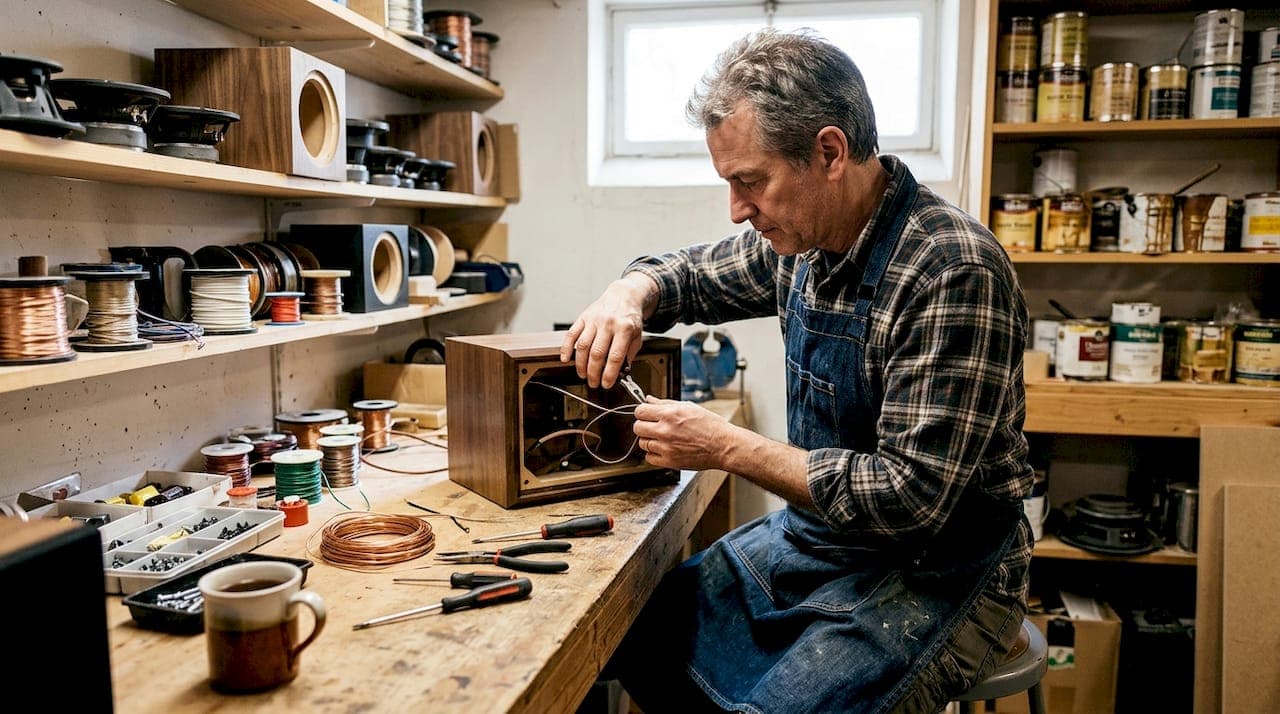
You've probably heard two speakers with nearly identical specifications and walked away preferring one without being able to explain why. The drivers look similar, the frequency response graphs overlap, and the price tags aren't far apart. Yet one of them pulls you in while the other leaves you cold. This guide digs into the question that haunts every serious listener: what separates a component that sounds technically correct from one that sounds genuinely right? The answer has less to do with raw specs and more to do with the skilled hands, chosen materials, and obsessive attention to detail that define true Hi-Fi craftsmanship.
Table of Contents
- What does craftsmanship mean in Hi-Fi?
- Materials and methods: How craftsmanship shapes sound
- The art of tuning: Why skilled hands matter more than specs
- Does craftsmanship always equal better sound? The debate
- Our take: Craftsmanship is the soul of memorable Hi-Fi
- Bring craftsmanship home with HiFi Rack
- Frequently asked questions
Key Takeaways
| Point | Details |
|---|---|
| Craftsmanship defined | True Hi-Fi craftsmanship means hand-built care, premium materials, and visual beauty that go beyond mere specifications. |
| Sound impact | Expert-selected materials and careful assembly minimize vibrations and enhance sound quality distinctively. |
| Tuning over specs | Skilled ear-tuning and obsessive attention to detail can create richer, more engaging audio experiences than specs alone. |
| Debate exists | Some mass-produced gear can rival handcrafted units by some metrics, but artisan pieces offer unique emotional and tactile value. |
| Choose with intent | Select Hi-Fi furniture where craftsmanship aligns with your aesthetic and acoustic needs for the optimal experience. |
What does craftsmanship mean in Hi-Fi?
Craftsmanship in Hi-Fi is not just a marketing word. It describes a specific approach to building audio equipment, one that prioritizes human judgment, premium materials, and finishing quality over production speed or cost efficiency. Where mass production relies on automated assembly lines and interchangeable tolerances, true craftsmanship asks a skilled technician to take responsibility for every component, every joint, every adjustment.
The difference shows up immediately in how components are put together. Hand-assembly by skilled technicians using premium materials ensures precision, vibration control, and aesthetic integration that enhances both sound purity and the overall user experience. KEF's Reference series and Magico's speakers, for example, are assembled by a single technician per unit, meaning one person is accountable for every tolerance and every connection. That level of personal responsibility is simply impossible to replicate at scale.
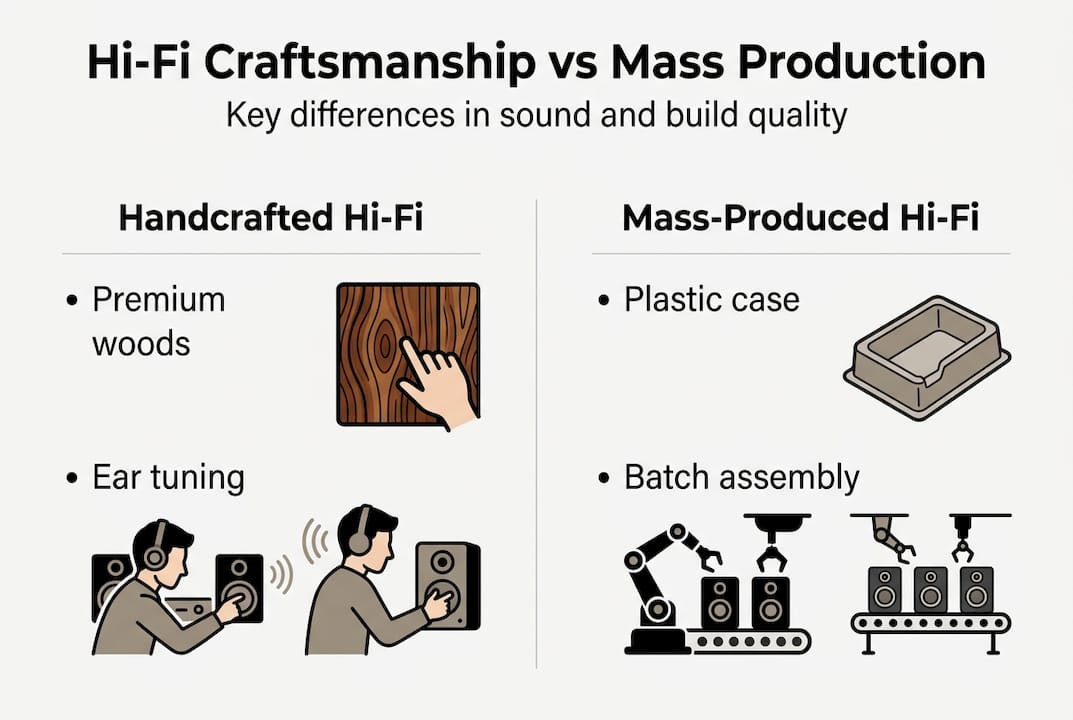
What makes this matter to you as a listener? Consider these key characteristics that distinguish handcrafted Hi-Fi from mass-produced alternatives:
- Precision component matching: Drivers, crossover parts, and internal wiring are selected and sometimes measured individually rather than pulled from a batch.
- Superior cabinet construction: Bracing, damping layers, and joint quality are executed by hand, reducing unwanted resonances.
- Thoughtful finishing: Surface treatments, veneers, and hardware are chosen for acoustic and aesthetic harmony, not just visual appeal.
- Longer listening before release: Many artisan builders spend days or weeks listening to a finished unit before it leaves the workshop.
"The experience of holding a well-made object, feeling its weight and finish, shapes how we perceive its performance before we even press play."
This tactile and visual dimension of craftsmanship matters more than most audiophiles admit. When you invest in a beautifully finished component or place your source components inside premium audio spaces designed with the same care, the entire listening experience shifts. You're not just hearing music. You're engaging with it.
Materials and methods: How craftsmanship shapes sound
Once you understand the philosophy, the next step is seeing how specific materials and methods produce audibly different results. Every material a builder chooses introduces a set of acoustic properties that interacts with the rest of the system.
Let's look at what high-end builders actually use and why it matters:
- Beryllium tweeters: Extremely stiff and light, reducing resonance at high frequencies and producing faster, more accurate transient response.
- Nanocarbon fiber woofers: Higher stiffness-to-mass ratio than conventional paper or polypropylene cones, delivering tighter bass and lower coloration.
- Aluminum baffles and enclosures: Rigid and non-resonant, preventing cabinet vibrations from muddying the soundstage.
- Rosewood and solid hardwood finishes: More than cosmetic; dense wood adds mass and damping where synthetic materials fall short.
Bang and Olufsen's 2026 anniversary speaker release is a clear example. Premium materials like rosewood and aluminum, paired with beryllium tweeters and nanocarbon fiber woofers, reduce resonances and push driver performance well beyond what standard production methods achieve.

| Feature | Handcrafted | Mass-produced |
|---|---|---|
| Cabinet material | Solid hardwood or aluminum | MDF or plastic |
| Driver selection | Individually matched | Batch-selected |
| Crossover components | Premium, hand-soldered | Standard, wave-soldered |
| Internal damping | Custom, layered | Generic foam |
| Finishing | Hand-applied veneers or paint | Machine-sprayed |
| Acoustic testing | Per-unit listening tests | Statistical sampling |
Handcrafted assembly also allows for precise component matching that batch production simply cannot guarantee. When crossover components are measured and paired by hand, the result is a more coherent soundstage and better imaging. Empirical benefits in imaging and dynamics from premium drivers seated in rigid, handcrafted cabinets become especially apparent in acoustically challenging rooms where mass-produced speakers struggle to stay composed.
Pro Tip: When evaluating a Hi-Fi rack or speaker, tap the cabinet firmly with your knuckle. A well-built unit produces a dull thud. A thin, resonant response tells you the enclosure will color your sound in ways no EQ can fix.
The art of tuning: Why skilled hands matter more than specs
Materials only go so far. What separates a good-sounding component from a genuinely engaging one is the tuning process, and that process requires ears, patience, and experience that no automated system can replicate.
Here is how a typical artisan builder approaches tuning:
- Initial assembly and break-in: The unit plays for anywhere from 50 to 200 hours before serious listening begins, allowing drivers and components to settle.
- Crossover adjustment by ear: Resistor and capacitor values are fine-tuned not just by measurement but by listening to specific test tracks chosen for their diagnostic value.
- Component swapping and matching: Artisan builders often try several capacitor brands or wire gauges in the same position, listening to each iteration before committing.
- Paired tuning: One craftsman tunes both speakers in a stereo pair together, ensuring that the two units share the same tonal character rather than being individually calibrated to a target curve.
- Final approval listening: The unit is evaluated on its musicality, not just its measurement results, before it leaves the shop.
This process is why ear-tuning and obsessive component selection in handcrafted Hi-Fi gear prioritizes musical engagement over specification matching. A Lejonklou amplifier, for example, may measure differently from a flagship mass-market unit but consistently earns praise for sounding more alive, more emotionally communicative, with real music.
The honest truth is that specs describe what a device does in a controlled environment. Tuning determines how it behaves with real music, real rooms, and real listeners. Those are very different challenges.
Pro Tip: Ask any artisan builder how they tune their gear. If they describe only measurement rigs and target curves, keep looking. The best builders can tell you exactly which tracks they used and why.
Does craftsmanship always equal better sound? The debate
Let's be fair. Not every handcrafted piece of audio equipment outperforms every mass-produced alternative. The relationship between craftsmanship and sound quality is real but not absolute.
The strongest argument against automatic craftsmanship superiority is transparency. A technically excellent solid-state amplifier built on an automated production line can measure extraordinarily well, achieving distortion levels and noise floors that even skilled artisan builders rarely match. Mass production can achieve transparency via specs in ways that artisan builds sometimes cannot, especially at mid-price points where automation improves consistency.
Some experienced listeners actually prefer the character of a handcrafted tube amplifier with higher measured distortion over a technically cleaner mass-market solid-state unit. That preference is not irrational. Second-harmonic distortion, common in tube designs, is generally perceived as warmth rather than error. The "imperfection" becomes part of the musical signature.
| Attribute | Handcrafted amplifier | Mass-produced amplifier |
|---|---|---|
| Distortion character | Often richer, harmonic overtones | Often lower, but can sound thin |
| Consistency | May vary unit-to-unit | Highly consistent |
| Repairability | Usually excellent | Often limited by parts availability |
| Aesthetic quality | Typically superior | Varies widely |
| Measured performance | Can be excellent or moderate | Often excellent at price point |
| Emotional engagement | Generally higher | Listener-dependent |
The most nuanced point in this debate is that fine details and finish improve perceived sound experience even without a measurable change in output. When you hold a beautifully machined volume knob or place your turntable on a rack made from solid walnut, your brain calibrates its expectations and your listening becomes more attentive and rewarding. This is not delusion. It is how human perception works, and smart audiophiles use it to their advantage. When you take the time to create a premium audio space that looks and feels as good as it sounds, everything about your listening improves.
Our take: Craftsmanship is the soul of memorable Hi-Fi
We spend a lot of time thinking about what makes a listening session truly memorable rather than merely technically impressive. After years of working with solid wood, obsessing over joinery, and talking to audiophiles who have heard everything, our honest view is this: craftsmanship does not guarantee measurably better sound, but it nearly always produces a deeper connection to the music.
The best handcrafted Hi-Fi pieces have a soul. They carry the decisions, the compromises, and the passion of someone who cared enough to get it right rather than just get it done. Not every artisan piece justifies its price, and we won't pretend otherwise. But the ones that do stand apart in a way that specs simply cannot describe.
Aesthetics and touch matter enormously. When you place your source components on a beautifully finished rack, you are creating a ritual around listening, and that ritual makes you listen more carefully, more often, and with greater satisfaction. Building an emotionally engaging audio space is not a luxury afterthought. It is part of the Hi-Fi experience itself.
Bring craftsmanship home with HiFi Rack
If this has you thinking about the physical environment your audio gear lives in, you are already asking the right question. The components you invest in deserve a foundation built with the same care and intention.
At HiFi Rack, we build solid wood Hi-Fi racks from responsibly sourced hardwoods, using traditional joinery and hand-applied finishes that bring the same craftsmanship philosophy to your audio furniture. Whether you are starting fresh or upgrading an existing setup, our Myro Racks & Stands combine vibration damping, structural integrity, and genuine beauty. Browse the HiFi Rack gallery for inspiration and see how the right rack can make your entire listening room feel intentional.
Frequently asked questions
Does handcrafted Hi-Fi always sound better than mass-produced models?
Not always. While craftsmanship frequently enhances sound quality and aesthetics, some mass-produced gear matches or exceeds artisan pieces based on measured specifications alone, particularly in transparency and consistency.
What materials should I look for in premium Hi-Fi furniture?
Seek solid woods, dense laminates, and metals like aluminum. These reduce vibrations and complement audio gear both acoustically and visually, as seen in how rosewood and aluminum improve driver performance in premium handcrafted speakers.
How does craftsmanship affect the longevity of Hi-Fi furniture and racks?
Handcrafted units offer improved durability, better joinery, and easier repairability than mass-market pieces, because hand-assembly for precision and longevity is built into the process from the start.
Can room acoustics impact the benefits of handcrafted audio furniture?
Yes, significantly. Well-made racks and cabinets especially excel in reflective or acoustically challenging rooms, where handcrafted rigid cabinets outperform mass-produced alternatives by delivering measurable improvements in imaging and dynamics.