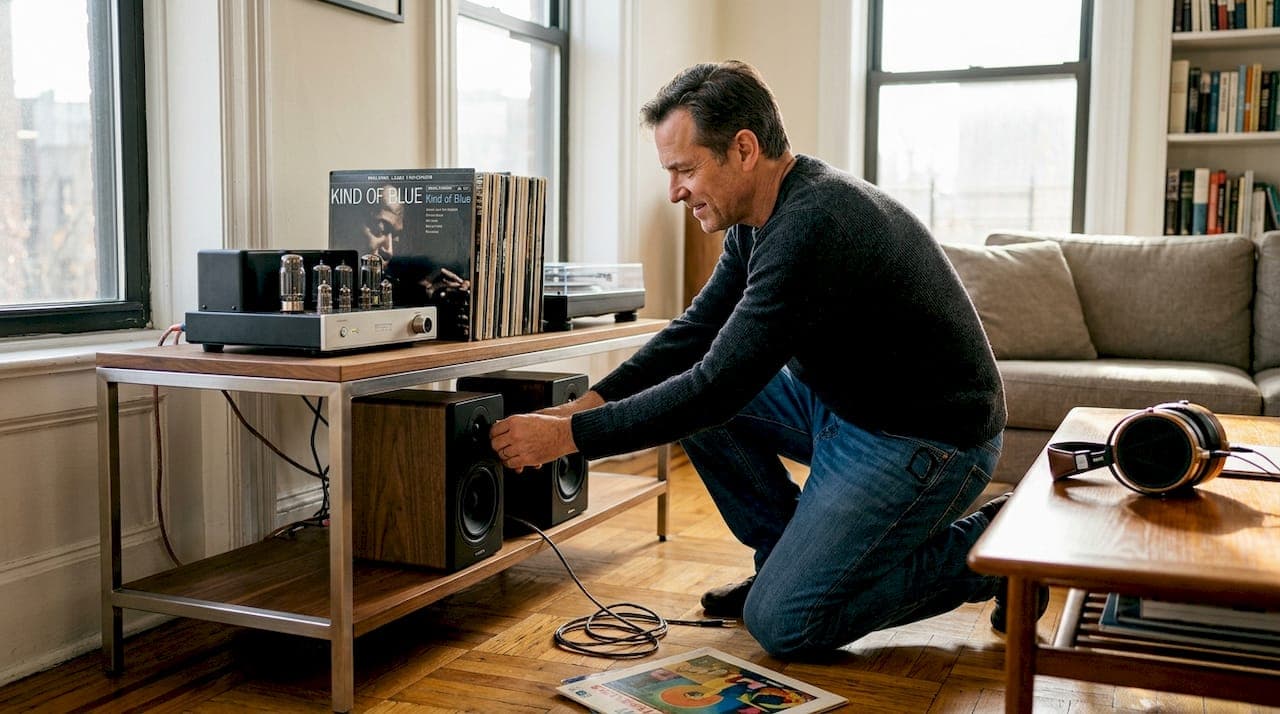
Most audiophiles spend thousands on amplifiers, DACs, and speakers, then set everything on a generic shelf and call it done. That decision quietly undermines every dollar spent upstream. Custom hi-fi stands are not decorative afterthoughts. They are precision tools that control vibration, reduce resonance, and anchor your equipment in exactly the right physical relationship to your room and your ears. The difference between a thoughtfully engineered stand and a flat-pack alternative is not subtle once you hear it. This guide walks through the sound quality benefits, design possibilities, budget realities, and selection criteria that matter most when you're ready to stop leaving performance on the table.
Table of Contents
- How custom hifi stands enhance sound quality
- Aesthetics and design flexibility of custom stands
- Performance versus budget: Custom vs. standard racks
- How to select the ideal custom hi-fi stand
- Why most audiophiles underestimate the role of custom racks
- Elevate your audio experience with expert-crafted stands
- Frequently asked questions
Key Takeaways
| Point | Details |
|---|---|
| Superior vibration control | Custom hi-fi stands use advanced materials and dampening methods for cleaner, clearer sound. |
| Personalized design options | You can match your hi-fi stand to any décor and layout for a seamless look. |
| Better long-term value | Custom stands provide lasting performance benefits especially for serious audio investments. |
| Optimal gear protection | Properly fitted custom racks shield sensitive audio equipment from unwanted external vibrations. |
How custom hifi stands enhance sound quality
Let's be direct: sound quality is not only about what's inside your components. It's also about what those components sit on. Every motor, transformer, and spinning platter generates VIBRATIONS, and those vibrations feed back into the signal path, smearing detail and muddying dynamics. A custom stand attacks this problem at the source.
Custom racks achieve vibration control through a combination of mass-loading, sorbothane (a dense polymer that absorbs mechanical energy), and tuned damping layers specifically designed to avoid resonant frequencies below 100Hz. That last point matters enormously for turntables, which are acutely sensitive to footfall and airborne vibration. A standard rack has no awareness of these resonant frequencies. A custom one is engineered around them.
What separates custom from off-the-shelf options in practice:
- Precision fit: Shelves sized to your exact components, eliminating wasted mass and overhang that can introduce flex.
- Material selection: Hardwoods like walnut, ash, and cherry each have distinct damping characteristics, chosen to complement your specific gear.
- Mass-loading options: Custom stands can incorporate sand-filled columns or heavy steel inserts to lower the rack's center of resonance.
- Sorbothane footers and spikes: Both are tunable, meaning they can be matched to your floor type and component weight.
- 3D CAD visualization: You see the finished result before a single piece of wood is cut.
| Feature | Custom stand | Generic stand |
|---|---|---|
| Vibration tuning | Engineered to spec | None or minimal |
| Material choice | Acoustic hardwoods | MDF, particle board |
| Fit to components | Exact dimensions | Approximate |
| Resonance control | Below 100Hz tuning | Uncontrolled |
| Longevity | Decades, heirloom grade | 3 to 7 years average |
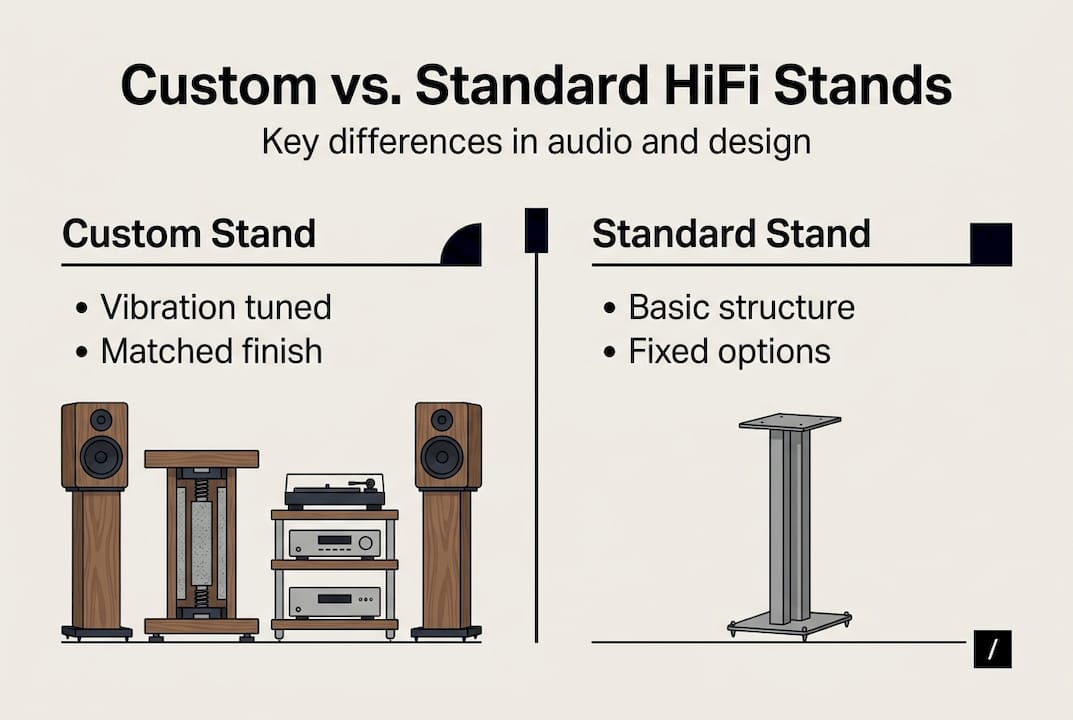
As experts confirm, custom hi-fi stands optimize the mechanical relationship between your equipment and the listening space, outperforming generic options in both performance and aesthetics. For anyone running a serious turntable or a stack of high-end separates, understanding hi-fi rack qualities is the logical first step before committing to any solution.
Pro Tip: If your listening room has a wooden suspended floor, mass-loading your rack's feet becomes especially important. Suspended floors transmit footfall energy directly into turntable styluses, adding wow and flutter that no cartridge upgrade can fix.
Aesthetics and design flexibility of custom stands
Beyond just sound, custom stands transform the look and function of your listening space. A mass-produced rack is designed for the widest possible buyer, which means it fits nobody perfectly. A custom stand is designed for you, your room, your equipment stack, and your eye.
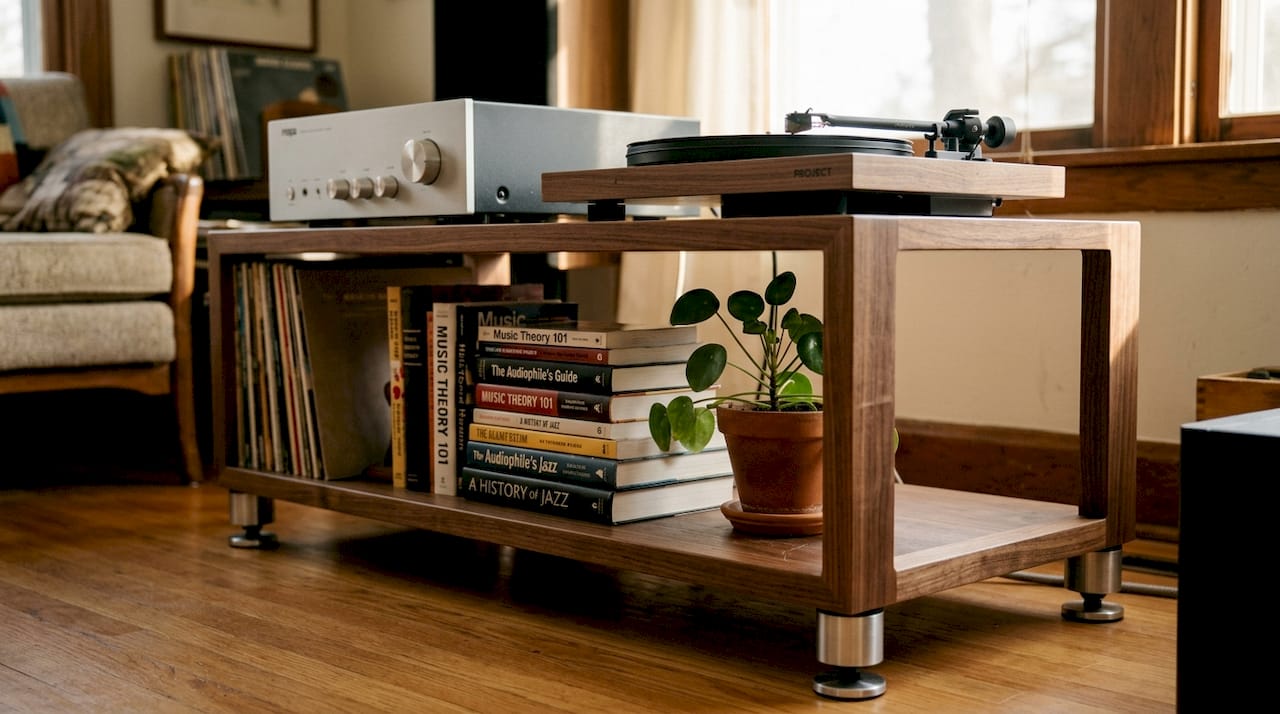
The design possibilities range from minimalist open-shelf walnut frames that disappear into a modern living room, to substantial multi-tier cherry or oak structures that become the visual centerpiece of a dedicated listening room. Finishes can be matched to existing furniture, flooring, or even the colorways of your loudspeakers.
What real design flexibility looks like for audiophiles:
- Wood species selection: Walnut, cherry, ash, oak, and maple each carry a distinct grain, color, and acoustic character. You're not choosing a catalog finish, you're choosing a natural material with its own personality.
- Shelf height customization: Components like integrated amplifiers and reel-to-reel decks often have irregular heights. Custom shelves eliminate the compromises that generic fixed-height racks force on you.
- Cable management integration: Routed channels and hidden access points keep your wiring invisible without compromising signal path integrity.
- Footprint optimization: Narrow listening rooms can be served by tall, slender profiles. Wide rooms can accommodate lower, broader layouts that anchor the space visually.
- Finish options: Oil finishes, hard wax, or lacquer, each with different tactile and visual results that age differently over time.
| Aspect | Custom stand | Standard stand |
|---|---|---|
| Finish matching | Fully matched to space | Fixed catalog options |
| Wood species | Audiophile-grade hardwoods | Often MDF or veneer |
| Dimension control | Built to your spec | Fixed sizes only |
| Cable routing | Integrated by design | Afterthought or absent |
| Visual character | Unique, natural grain | Uniform, mass-produced |
As established sources note, precise fit and aesthetic integration are not separate concerns, they work together to create a listening environment where your system feels at home rather than just placed there.
Performance versus budget: Custom vs. standard racks
This design freedom comes at a price, so let's weigh how custom racks stack up against off-the-shelf choices. The honest answer is nuanced, and it depends heavily on where your system is right now.
A common and fair perspective is that budget racks with DIY tweaks like spikes, blu-tack, and rubber footers can deliver meaningful improvements at low cost, and some audiophiles find them sufficient. That's true for entry-level systems. But experts consistently note that as component quality rises, the performance ceiling of generic hardware becomes a real constraint, particularly in vibration control.
Here is how the two categories compare across the factors that matter most:
- Initial cost: Custom racks carry higher upfront investment, but the build quality justifies the price over a decade or more of use.
- Vibration engineering: Off-the-shelf racks are not tuned to specific resonant frequencies. Proper vibration tuning using 3D CAD, sorbothane, and mass-loading is a custom-only capability.
- Longevity: Solid hardwood construction outlasts MDF alternatives by many years, making the per-year cost of a custom rack surprisingly competitive.
- Upgrade path: A custom rack can be designed with your future components in mind, so you're not replacing the rack every time you upgrade your gear.
- Resale and collector value: High-quality handcrafted audio furniture holds value in a way that flat-pack alternatives simply do not.
"The rack is not a passive participant in your system. It is an active mechanical interface between your components and the environment. Treat it as a component, not as furniture."
Visiting the hifi audio tips section on our site gives you a clearer picture of the engineering decisions that separate serious racks from decorative shelving, and helps you frame your own cost-benefit thinking.
How to select the ideal custom hi-fi stand
Finally, if you're considering the custom route, here's how to make the most informed choice for your system. The process is more methodical than browsing a product catalog, and that's exactly why it produces better results.
Start by mapping your current equipment and your realistic upgrade path over the next five years. The dimensions, weight, and heat output of each component inform everything else: shelf spacing, load capacity, and ventilation strategy. Don't design for today's system if you plan to add a large monoblock pair or a reel-to-reel within two years.
Key selection criteria to work through:
- Component inventory: List every piece of gear with its exact height, depth, and weight. Include power supplies and outboard units often forgotten in the planning stage.
- Vibration priorities: Identify which components are most sensitive. Turntables and DACs are the most demanding. Amplifiers and streamers are more forgiving.
- Floor type: Suspended timber floors require more aggressive decoupling than concrete slabs. Your craftsman needs to know this upfront.
- Room dimensions and flow: A stand that looks proportional in a photo may overwhelm a smaller room. Measure wall space, not just the component stack.
- Material and finish brief: Bring reference images from your room. Natural wood has character; choosing a species that works with your existing materials makes the final piece feel inevitable rather than added.
A quality craftsman will walk you through 3D CAD visualization before production begins, letting you approve dimensions, proportions, and finish before a single piece of hardwood is cut. That step alone eliminates the regret that comes with generic purchases.
Pro Tip: Ask your builder to specify the resonant frequency profile of the finished rack. A rack engineered to stay above your most sensitive component's vibration threshold is a fundamentally different product from one that just looks solid.
For those ready to explore options, browsing solid wood hi-fi stands gives you a tangible reference point for what well-executed custom audio furniture actually looks and feels like in practice.
Why most audiophiles underestimate the role of custom racks
Stepping back, there's a pattern we see repeatedly. Audiophiles will spend months agonizing over cable choices, argue fervently about DAC chips, and upgrade their phono cartridge twice in a year. Then they set everything on an IKEA shelf or a mass-produced rack and consider the system complete. It's a telling contradiction.
The rack is not the exciting purchase. It doesn't have a spec sheet you can compare online. But it is the mechanical foundation of the entire system, and hi-fidelity philosophy teaches us that every element in the chain deserves the same attention you give your electronics.
We've spoken with audiophiles who replaced budget racks with properly engineered custom solutions and described the result not as a subtle improvement but as finally hearing what their speakers were always capable of. That's not marketing language. That's what happens when VIBRATIONS stop interfering with the signal.
Custom racks are where craft and acoustics meet. And once you hear the difference, going back feels like a genuine step backward.
Elevate your audio experience with expert-crafted stands
Ready to take your listening room to the next level? Everything we've covered in this guide, from vibration engineering and material selection to precise dimensional fit and aesthetic integration, is exactly what we put into every rack we build at hifi-rack.com. Our four-generation woodworking heritage means we approach every project with both the technical understanding and the hands-on craft to deliver something that performs as well as it looks.
Browse our shop custom hi-fi racks to see the full range of available options and configurations. If you want to see how our builds integrate into real listening rooms, discover Myro racks for a closer look at what precision-crafted audio furniture looks like when everything is done right. We're also happy to talk through your specific setup before you commit to anything.
Frequently asked questions
What makes a custom hi-fi stand better than a standard one?
Custom hi-fi stands are engineered for vibration control, precise component fit, and aesthetic integration in ways that mass-produced options simply cannot match. For serious audiophiles, that engineering difference translates directly into audible improvements.
Are there budget-friendly ways to improve standard audio racks?
Yes, DIY tweaks like spikes and blu-tack can provide modest gains on a budget rack, but they don't replicate the engineered vibration management that a purpose-built custom rack delivers from the ground up.
Do custom stands really affect turntable performance?
Absolutely. Turntables are sensitive to resonant frequencies below 100Hz, including footfall and airborne vibration, and a custom stand tuned with sorbothane and mass-loading addresses those threats directly in a way generic furniture cannot.
How should I choose dimensions for a custom hi-fi stand?
Start with a full inventory of your current and planned components, measure your room carefully, and work with your builder through 3D CAD visualization to confirm proportions, ventilation, and load distribution before production begins.